
SchNet-driven NVE dynamics: energy conservation by construction#
Note: Run schnet_rmd17_train.ipynb first as it
writes the runs/schnet_rmd17/best.pt checkpoint (saved by the
trainer’s ModelCheckpoint callback) consumed by this notebook.
One of the central design claims of the SchNet manuscript is that predicting the energy and differentiating it yields a curl-free, energy-conserving force field. Combined with the infinitely differentiable shifted-softplus, this is one of the key reasons making SchNet usable for molecular dynamics.
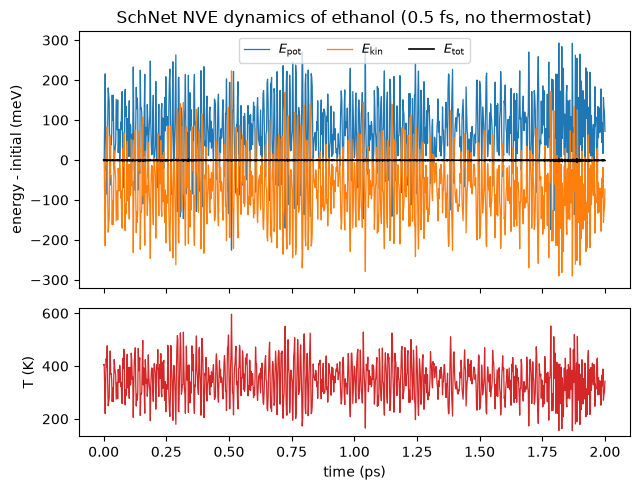
This notebook tests this claim: it loads the SchNet trained on rMD17 ethanol by
schnet_rmd17_train.ipynb, drives ASE NVE
(velocity-Verlet) dynamics with it through XNNCalculator, and checks whether
total energy is conserved while kinetic and potential energy exchange freely.
0. Load the trained SchNet and wrap it as an ASE calculator#
import time
import warnings
warnings.filterwarnings("ignore")
import numpy as np
import torch
import matplotlib.pyplot as plt

torch.manual_seed(0)
np.random.seed(0)

import xnn
from xnn.common.data import load_dataset
from xnn.common.deploy import XNNCalculator
from xnn.common.models.hub import load_pretrained

from ase import Atoms, units
from ase.md.velocitydistribution import (MaxwellBoltzmannDistribution,
                                         Stationary, ZeroRotation)
from ase.md.verlet import VelocityVerlet
# Set the device
DEVICE = "cuda" if torch.cuda.is_available() else "cpu"

# Load the best checkpoint of the training run: the model is rebuilt from the
# config stored with the weights and served in their dtype (float64)
CKPT = "runs/schnet_rmd17/best.pt"
loaded = load_pretrained(CKPT, device=DEVICE)

# Create the ASE calculator
calc = XNNCalculator(loaded.model, cutoff=loaded.cutoff, device=DEVICE)

# Print the model information
cfg = loaded.config.model
print(f"xnn {xnn.__version__} | loaded {CKPT} "
      f"(F={cfg.n_features}, T={cfg.n_interactions}, "
      f"cutoff={loaded.cutoff} A, {calc.dtype}) on {DEVICE}")
xnn 0.13.0 | loaded runs/schnet_rmd17/best.pt (F=64, T=3, cutoff=10.0 A, torch.float64) on cpu
1. NVE molecular dynamics of ethanol#
We start from a held-out rMD17 conformation, draw 300 K Maxwell–Boltzmann velocities, and integrate with velocity Verlet at a 0.5 fs time step (the resolution of the reference trajectories in the SchNet manuscript) for 2 ps.
We do not use a thermostat so that in the NVE ensemble, any error in the forces shows up directly as drift or noise in the total energy.
# Load the ethanol dataset
s = load_dataset("rmd17", molecule="ethanol", split="test", n_test=1,
                 quiet=True)[0]

# Initialize the ASE Atoms object
atoms = Atoms(numbers=s["atomic_numbers"], positions=s["pos"])

# Attach the calculator to the atoms
atoms.calc = calc

# Set the initial velocities
MaxwellBoltzmannDistribution(atoms, temperature_K=300)

# Remove the center of mass motion and rotation
Stationary(atoms)
ZeroRotation(atoms)

# 2 ps
DT_FS, N_STEPS = 0.5, 4000

# Initialize the molecular dynamics
dyn = VelocityVerlet(atoms, timestep=DT_FS * units.fs)

# Record the trajectory
t_ps, e_pot, e_kin, temp = [], [], [], []
def record(a=atoms):
    t_ps.append(dyn.nsteps * DT_FS / 1000.0)
    e_pot.append(a.get_potential_energy())
    e_kin.append(a.get_kinetic_energy())
    temp.append(a.get_temperature())

# Attach the recording function to the molecular dynamics
dyn.attach(record, interval=4)

# Run the molecular dynamics
t0 = time.time()
record()
dyn.run(N_STEPS)

# Print the results
print(f"{N_STEPS} NVE steps ({N_STEPS*DT_FS/1000:.1f} ps) "
      f"in {time.time()-t0:.0f}s")

# Calculate the total energy
e_pot, e_kin = np.array(e_pot), np.array(e_kin)
e_tot = e_pot + e_kin
4000 NVE steps (2.0 ps) in 11s
2. Total-energy conservation#
# Fit a line to the dynamics data to determine the energy drift (in meV/ps)
drift = np.polyfit(t_ps, (e_tot - e_tot[0]) * 1e3, 1)[0]

# Print the results
print(f"potential-energy fluctuation : {e_pot.std()*1e3:8.2f} meV")
print(f"total-energy fluctuation     : {e_tot.std()*1e3:8.3f} meV")
print(f"total-energy drift           : {drift:8.3f} meV/ps")
print(f"conservation ratio  std(E_tot)/std(E_pot) = "
      f"{e_tot.std()/e_pot.std():.4f}")

# Plot the NVE dynamics data
fig, (a1, a2) = plt.subplots(2, 1, figsize=(6.5, 5), sharex=True,
                             height_ratios=[2, 1])
a1.plot(t_ps, (e_pot - e_pot[0]) * 1e3, label=r"$E_\mathrm{pot}$", lw=0.9)
a1.plot(t_ps, (e_kin - e_kin[0]) * 1e3, label=r"$E_\mathrm{kin}$", lw=0.9)
a1.plot(t_ps, (e_tot - e_tot[0]) * 1e3, "k", label=r"$E_\mathrm{tot}$", lw=1.2)
a1.set_ylabel("energy - initial (meV)")
a1.set_title("SchNet NVE dynamics of ethanol (0.5 fs, no thermostat)")
a1.legend(ncols=3, fontsize=9)
a2.plot(t_ps, temp, lw=0.9, color="tab:red")
a2.set_xlabel("time (ps)")
a2.set_ylabel("T (K)")
fig.tight_layout()
fig.savefig("schnet_nve_energy.png", dpi=110)
plt.show()
potential-energy fluctuation :    86.15 meV
total-energy fluctuation     :    0.947 meV
total-energy drift           :   -0.122 meV/ps
conservation ratio  std(E_tot)/std(E_pot) = 0.0110
Summary#
Kinetic and potential energy exchange on the 100 meV scale while the total energy fluctuates by under a meV (about 1% of the potential-energy fluctuation) with no systematic drift over 2 ps of thermostat-free dynamics. Thus, the resulting atomic forces of SchNet, computed by the autograd are conservative to integration accuracy as guaranteed by construction.