
5. Lesson 03a: Tensor Products and Coupling Irreps with Clebsch–Gordan Coefficients#
What you will learn
What the tensor product of representations is, and why it is the natural way to combine two equivariant features.
The Clebsch–Gordan decomposition \(l_1 \otimes l_2 = |l_1 - l_2| \oplus \cdots \oplus (l_1 + l_2)\) and the parity rule \(p_3 = p_1 p_2\).
Clebsch–Gordan coefficients as an orthogonal change of basis that block-diagonalizes the product representation.
The dot product, cross product, and symmetric traceless outer product of two vectors are exactly the three paths of \(1 \otimes 1 = 0 \oplus 1 \oplus 2\). We will numerically verify this concept.
Why (by Schur’s lemma) tensor-product paths are the only equivariant bilinear maps.
Prerequisites:
Lesson 01b: representations, Schur’s lemma, Wigner \(D\)-matrices,
Lesson 02a:
o3.Irreps,Lesson 02b: spherical harmonics.
import sys
sys.path.insert(0, "..")

import torch
import matplotlib.pyplot as plt
from e3nn import o3

from course_utils.equivariance import assert_equivariant
from course_utils.plotting import plot_tp_selection_rules

torch.set_default_dtype(torch.float64)   # Equivariance checks need double precision
torch.manual_seed(0)
device = "cuda" if torch.cuda.is_available() else "cpu"
print(f"torch {torch.__version__}, device = {device}")
torch 2.7.1+cu126, device = cuda
5.1. Why couple two irreps?#
Lesson 02 gave us equivariant objects: features labelled by an irrep \((l, p)\) that transform with a Wigner matrix \(D^{(l)}(g)\) under \(g \in O(3)\). An equivariant network must now combine these features, e.g. multiply a node feature by the spherical-harmonic embedding \(Y^{(l)}(\hat r_{ij})\) of an edge direction (that is precisely the convolution we use in Lesson 06).
Ordinary elementwise multiplication of components is not allowed: components of different irreps mix under rotation. So, an arbitrary componentwise product does not transform as any irrep. The operation that is allowed is the tensor product \(x \otimes y\): “the equivariant multiplication operation for two representations”, which is (i) bilinear in \(x\) and \(y\) and (ii) equivariant. This notebook focuses on building this operation from scratch and Lesson 03b then dissects its optimized implementation in e3nn.
5.2. The tensor product of two representations#
Let \(x \in \mathbb{R}^{2l_1+1}\) transform with \(D^{(l_1)}(g)\) and \(y \in \mathbb{R}^{2l_2+1}\) with \(D^{(l_2)}(g)\). Their tensor (outer) product is the array of all pairwise products,
and it transforms with the Kronecker product of the two representation matrices \(D^{X} \otimes D^{Y} = D^{X \otimes Y}\) (see Thomas et al. 2018):
where
So, \(x \otimes y\) is again an equivariant object, but it lives in a reducible representation. The \(D^{(l_1)} \otimes D^{(l_2)}\) is a valid representation of \(O(3)\). Let us check both facts numerically for two vectors (\(l_1 = l_2 = 1\)).
# A vector (irrep 1o), e3nn component order (y, z, x)
l1, l2 = 1, 1
x = torch.randn(2 * l1 + 1)
y = torch.randn(2 * l2 + 1)

# Random rotation in SO(3)
R = o3.rand_matrix()

# D^(1)(R), the 3x3 Wigner matrix
D1 = o3.Irrep(l1, -1).D_from_matrix(R)
D2 = o3.Irrep(l2, -1).D_from_matrix(R)

# Rotate first, then take the outer product ...
lhs = torch.outer(D1 @ x, D2 @ y).flatten()

# ... vs. take the outer product, then act with the Kronecker representation
# 9x9 matrix D^(1) x D^(1)
D_kron = torch.kron(D1, D2)
rhs = D_kron @ torch.outer(x, y).flatten()

# Check that the two sides are equal (up to numerical precision)
print("outer product is equivariant:", torch.allclose(lhs, rhs))
print("D_kron is orthogonal        :", torch.allclose(D_kron @ D_kron.T, torch.eye(9)))
print("but D_kron is NOT block-diagonal: it mixes all 9 components (see Sec. 3).")
outer product is equivariant: True
D_kron is orthogonal        : True
but D_kron is NOT block-diagonal: it mixes all 9 components (see Sec. 3).
5.3. Clebsch–Gordan decomposition and selection rules#
Because every representation of \(O(3)\) decomposes into irreps (Lesson 01b), so does \(D^{(l_1)} \otimes D^{(l_2)}\). The classical result (the Clebsch–Gordan (CG) series) is
With the parity rule for \(O(3) = SO(3) \times \{1, P\}\), the selection rule for a \(l_3\) in the range of \(l\) values mentioned above can be stated as:
Each allowed \((l_3, p_3)\) tuple is called a path and there are \(l_1 + l_2 - |l_1 - l_2| + 1\) of them. A quick dimension check for \(1 \otimes 1 = 0 \oplus 1 \oplus 2\): \(\;3 \times 3 = 9 = 1 + 3 + 5\).
The Clebsch–Gordan (CG) coefficients \(C^{(l_3, m_3)}_{(l_1, m_1)(l_2, m_2)}\) allow for the change of basis that realizes this decomposition, in which the \(l_3\)-component of the product becomes
In e3nn, the (real-basis, symmetrically normalized) CG coefficients are returned by o3.wigner_3j(l1, l2, l3) as a tensor \(C_{ijk}\) of shape \((2l_1{+}1,\, 2l_2{+}1,\, 2l_3{+}1)\). Their defining property is invariance under the simultaneous action of the three Wigner matrices:
Let us implement the selection rules as a amultiplication of Irrep objects in e3nn:
# Loop over some irrep pairs
for a, b in [("1o", "1o"), ("1o", "2e"), ("0o", "1o"), ("2e", "2e")]:

    # Compute the tensor product of the two irreps
    prod = list(o3.Irrep(a) * o3.Irrep(b))

    # Print the result in a nice format
    dims = f"{o3.Irrep(a).dim} x {o3.Irrep(b).dim} = {sum(ir.dim for ir in prod)}"
    print(f"{a} x {b} = {' + '.join(str(ir) for ir in prod):<20s} (dims: {dims})")
1o x 1o = 0e + 1e + 2e         (dims: 3 x 3 = 9)
1o x 2e = 1o + 2o + 3o         (dims: 3 x 5 = 15)
0o x 1o = 1e                   (dims: 1 x 3 = 3)
2e x 2e = 0e + 1e + 2e + 3e + 4e (dims: 5 x 5 = 25)
We can also numerically verify the invariance property in Eq. (7)
# The CG/Wigner-3j tensors
# C[l3] has shape (3, 3, 2*l3+1)
C = {l3: o3.wigner_3j(1, 1, l3) for l3 in (0, 1, 2)}

# Random rotation in SO(3)
R = o3.rand_matrix()

# Check invariance property of CG coefficients (Eq. 7)
err = max(
    (torch.einsum("il,jm,kn,ijk->lmn",
                  o3.Irrep(1, 1).D_from_matrix(R),          # D^(l1)(R)
                  o3.Irrep(1, 1).D_from_matrix(R),          # D^(l2)(R)
                  o3.Irrep(l3, 1).D_from_matrix(R),         # D^(l3)(R)
                  C[l3]) - C[l3]).abs().max().item()
    for l3 in (0, 1, 2)
)
print(f"max |C - (D x D x D) C| over l3 = 0,1,2 :  {err:.2e}")
max |C - (D x D x D) C| over l3 = 0,1,2 : 1.39e-15
5.3.1. CG coefficients as an orthogonal change of basis#
Here, we stack the three CG tensors \(C^{(0)}\), \(C^{(1)}\), and \(C^{(2)}\) in a new tensor \(Q\) (reshaped to \(9 \times (2l_3+1)\) and rescaled by \(\sqrt{2l_3+1}\)). The e3nn package normalizes each whole tensor to unit Frobenius norm, so each of its \(2l_3{+}1\) columns has norm \(1/\sqrt{2l_3+1}\) into a single \(9 \times 9\) matrix
The resulting \(Q\) matrix is orthogonal, and conjugating the Kronecker representation of \(D^{(1)}(g) \otimes D^{(1)}(g)\) with it yields the block-diagonal representation of the three irreps:
# Stack the three CG tensors (reshaped to 9 x (2l3+1) and rescaled by sqrt(2l3+1))
Q = torch.cat([C[l3].reshape(9, 2 * l3 + 1) * (2 * l3 + 1) ** 0.5 for l3 in (0, 1, 2)], dim=1)

# Check that Q is orthogonal
print("Q is orthogonal:", torch.allclose(Q.T @ Q, torch.eye(9)))

# Create a random rotation
R = o3.rand_matrix()

# Compute the Kronecker product of the two 1D irreps
D_kron = torch.kron(o3.Irrep(1, -1).D_from_matrix(R), o3.Irrep(1, -1).D_from_matrix(R))

# Change of basis of D^(1) x D^(1)
# Block-diagonal representation of the three irreps
D_block = Q.T @ D_kron @ Q

# Compute the direct sum of the three irreps
# Used for comparison
D_direct_sum = o3.Irreps("0e + 1e + 2e").D_from_matrix(R)
print("Q^T (D x D) Q = D^(0) + D^(1) + D^(2):",
      torch.allclose(D_block, D_direct_sum, atol=1e-12))

# Plot the two representations of D^(1) x D^(1)
fig, axes = plt.subplots(1, 2, figsize=(9, 4))
for ax, M, title in [(axes[0], D_kron, r"$D^{(1)} \otimes D^{(1)}$ (dense, reducible)"),
                     (axes[1], D_block, r"$Q^\top (D^{(1)} \otimes D^{(1)}) Q$ (block-diagonal)")]:
    im = ax.imshow(M, cmap="RdBu_r", vmin=-1, vmax=1)
    ax.set_title(title, fontsize=10)
    ax.set_xticks(range(9))
    ax.set_yticks(range(9))

fig.colorbar(im, ax=axes, shrink=0.8, label="matrix element")
plt.show()
Q is orthogonal: True
Q^T (D x D) Q = D^(0) + D^(1) + D^(2): True
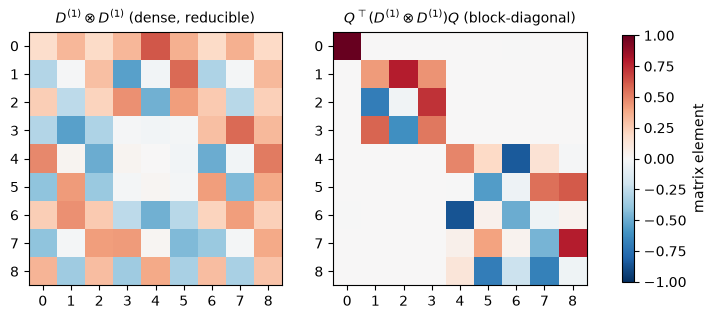
The right panel shows the block-diagonal structure: a \(1{\times}1\) block (\(l_3{=}0\)), a \(3{\times}3\) block (\(l_3{=}1\)), and a \(5{\times}5\) block (\(l_3{=}2\)). The same rotation \(R\) can now act on each block independently. This is what decomposing the tensor product into irreps means concretely.
5.3.2. The parity rule \(p_3 = p_1 p_2\)#
Under the inversion operation, \(P: \vec r \mapsto -\vec r\), an irrep \((l, p)\) is multiplied by \(p = \pm 1\). A product \(x_{m_1} y_{m_2}\) therefore picks up the factor \(p_1 p_2\): every \(l_3\) inherits the same parity \(p_3 = p_1 p_2\). This has a famous consequence: for two polar vectors (irrep \(1o\), e.g. positions) the resulting tensor product yields \(1o \otimes 1o = 0e \oplus 1e \oplus 2e\) where the \(l_3 = 1\) part is a pseudovector (\(1e\), axial vector), exactly like the physicist’s cross product \(\vec x \times \vec y\) (angular momentum, magnetic field). This pseudovector does not flip sign under inversion because the two sign flips of \(x\) and \(y\) cancel.
5.4. The three paths of \(1 \otimes 1\): dot, cross, and symmetric traceless outer product#
The low-\(l\) real CG coefficients are famous mathematical entities and deserve a special mention. In particular,
which correspond to the Kronecker delta and the Levi-Civita symbol, respectively. In other words, the \(l_3 = 0\) path of two vectors is the dot product and the \(l_3 = 1\) path is the cross product. Furthermore, the remaining \(l_3 = 2\) path is the symmetric traceless part of the outer product \(x y^\top\).
We now verify all three operations in torch. As mentioned, the e3nn’s wigner_3j is normalized to unit Frobenius norm, so in each identity we have to consider an explicit constant.
# Two generic vectors, e3nn order (y, z, x)
x, y = torch.randn(3), torch.randn(3)

# l3 = 0 path <-> dot product:  C^(0)_ij = delta_ij / sqrt(3)
# Shape (1,)
out0 = torch.einsum("ijk,i,j->k", C[0], x, y)

# Check that the l3=0 path is indeed the dot product
print("C^(0) equals I/sqrt(3):", torch.allclose(C[0][:, :, 0], torch.eye(3) / 3**0.5))
print(f"sqrt(3) * (l3=0 path) = {3**0.5 * out0.item():+.6f}")
print(f"torch.dot(x, y)       = {torch.dot(x, y).item():+.6f}")
C^(0) equals I/sqrt(3): True
sqrt(3) * (l3=0 path) = -1.573034
torch.dot(x, y)       = -1.573034
# l3 = 1 path <-> cross product:  C^(1)_ijk = epsilon_ijk / sqrt(6)
# Shape (3,), still in e3nn order (y, z, x)
out1 = torch.einsum("ijk,i,j->k", C[1], x, y)

# e3nn (y, z, x)  ->  Cartesian (x, y, z)
to_cart = [2, 0, 1]

# Check that the l3=1 path is indeed the cross product
print("sqrt(6) * (l3=1 path) =", (6**0.5 * out1[to_cart]).tolist())
print("torch.cross(x, y)     =", torch.cross(x[to_cart], y[to_cart], dim=0).tolist())
sqrt(6) * (l3=1 path) = [-0.6707221450230757, -0.3104339305635142, -0.058263167725321384]
torch.cross(x, y)     = [-0.6707221450230758, -0.31043393056351426, -0.05826316772532135]
# l3 = 2 path <-> symmetric traceless outer product
# Full outer product x y^T
T = torch.outer(x, y)

# The symmetric traceless part
S = 0.5 * (T + T.T) - torch.eye(3) * T.trace() / 3

# Antisymmetric + trace remainder
A = T - S

# The l3 = 2 path, 5 components
out2 = torch.einsum("ijk,i,j->k", C[2], x, y)
print("C^(2) : T == C^(2) : S       :", torch.allclose(out2, torch.einsum("ijk,ij->k", C[2], S)))
print(f"C^(2) : (antisym + trace)    : {torch.einsum('ijk,ij->k', C[2], A).abs().max():.1e}")
print("|out2| == |S|_F / sqrt(5)    :", torch.allclose(out2.norm(), S.norm() / 5**0.5))

# And the change of basis is invertible: recover the 3x3 matrix S from the 5 components
S_rec = 5 * torch.einsum("ijk,k->ij", C[2], out2)
print("S recovered from 5 components:", torch.allclose(S_rec, S))
C^(2) : T == C^(2) : S       : True
C^(2) : (antisym + trace)    : 0.0e+00
|out2| == |S|_F / sqrt(5)    : True
S recovered from 5 components: True
So the CG coefficients can reproduce vector algebra exactly:
path |
output irrep |
classical operation |
|---|---|---|
\(1o \otimes 1o \to 0e\) |
scalar |
\(\vec x \cdot \vec y\) |
\(1o \otimes 1o \to 1e\) |
pseudovector |
\(\vec x \times \vec y\) |
\(1o \otimes 1o \to 2e\) |
rank-2 symmetric traceless |
\(\tfrac12(x y^\top + y x^\top) - \tfrac13 (\vec x \cdot \vec y)\, I\) |
The last check above also shows why the \(l = 2\) irrep is 5-dimensional: a symmetric traceless \(3 \times 3\) matrix has \(6 - 1 = 5\) independent entries, and the CG matrix \(\sqrt{5}\,C^{(2)}\) is an orthogonal map between the two descriptions.
5.5. Selection rules at a glance#
In the course utility folder, we have provided course_utils.plotting.plot_tp_selection_rules function which tabulates \(\mathrm{ir}_1 \otimes \mathrm{ir}_2\) for every pair of input irreps: The multiplication table of \(O(3)\) irreps.
ax = plot_tp_selection_rules("0e + 0o + 1o + 1e + 2e", "0e + 1o + 2e")
plt.show()
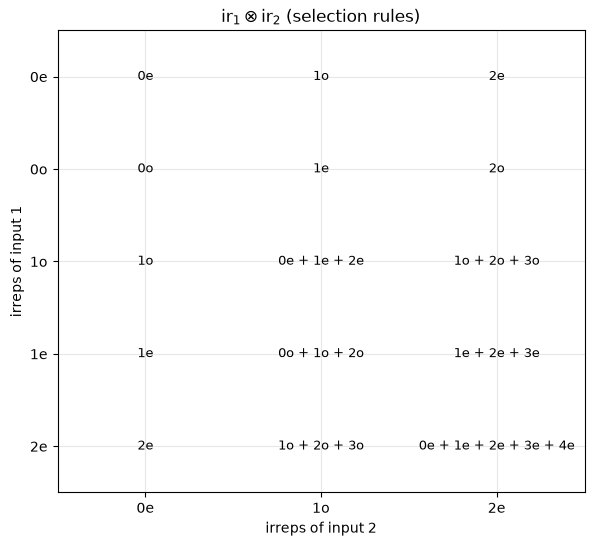
In the table above, note how parities multiply (\(o \times o = e\), \(e \times o = o\)) and how higher \(l\) inputs produce wider ranges of output \(l\).
5.6. Why tensor products are the only equivariant bilinear maps#
The tensor products are the central operation of equivariant networks because:
They are bilinear or linear on the product space. Any bilinear mapping, \(B: V_1 \times V_2 \to V_3\), factors uniquely through the tensor-product space: \(B(x, y) = L(x \otimes y)\) for a linear map \(L: V_1 \otimes V_2 \to V_3\). If \(B\) is equivariant, \(L\) is an intertwiner (commutes with the group action).
The tensor product, \(V_1 \otimes V_2\), decomposes and splits into irreps \(\bigoplus_{l_3} V^{(l_3, p_3)}\) with the CG change of basis.
Schur’s lemma (Lesson 01b): an intertwiner between two irreps is zero if the irreps are different and a scalar multiple of the identity if they are the same.
Hence every equivariant bilinear map is a weighted sum of CG paths: one free scalar \(w\) per allowed \((l_1, l_2) \to l_3\) path, and nothing else. There is no cleverer equivariant way to multiply two features: the only freedom a network has is which paths to use and with what weights. That freedom is exactly what o3.TensorProduct in e3nn parametrizes (Lesson 03b).
Let us verify Schur’s counting numerically: we solve for all bilinear maps \(B_{ijk} x_i y_j \;(= \text{output}_k)\) from \(1 \otimes 1\) into \(l_3\) that commute with rotations, by finding the null space of the linear constraints \(\big[D^{(1)} \otimes D^{(1)} \otimes D^{(l_3)} - I\big]\, \mathrm{vec}(B) = 0\) stacked over several random rotations. The dimension of that null space is the number of independent equivariant bilinear maps: it should be 1 for each allowed \(l_3 \in \{0, 1, 2\}\) and 0 for the forbidden \(l_3 = 3\).
# Count the number of independent equivariant bilinear maps l1 x l2 -> l3
def n_equivariant_bilinear_maps(l1, l2, l3, n_rot=8, tol=1e-10):
    '''dim of the space of rotation-equivariant bilinear maps  l1 x l2 -> l3.'''

    # The dimension of the space of bilinear maps is (2l1+1)(2l2+1)(2l3+1)
    dim = (2 * l1 + 1) * (2 * l2 + 1) * (2 * l3 + 1)

    # Loop over random rotations and stack the constraints
    rows = []
    for _ in range(n_rot):
        # Generate a random rotation
        R = o3.rand_matrix()

        # Compute the Wigner matrices for the three irreps
        Ds = [o3.Irrep(l, 1).D_from_matrix(R) for l in (l1, l2, l3)]

        # Append the constraint: D^(l1)(R) x D^(l2)(R) x D^(l3)(R) - I = 0
        rows.append(torch.kron(Ds[0], torch.kron(Ds[1], Ds[2])) - torch.eye(dim))

    # Null space of stacked constraints
    sing = torch.linalg.svdvals(torch.cat(rows))

    # Count the number of singular values that are effectively zero (within
    # tolerance)
    return int((sing < tol).sum())

# Count the number of independent equivariant bilinear maps l1 x l2 -> l3
# where l1 = l2 = 1, and l3 = 0, 1, 2, 3.
for l3 in (0, 1, 2, 3):

    # Compute the number of independent equivariant bilinear maps
    n = n_equivariant_bilinear_maps(1, 1, l3)

    # Check if the map is allowed by the triangle inequality (Eq. 5)
    allowed = "allowed" if abs(1 - 1) <= l3 <= 1 + 1 else "FORBIDDEN by Eq. (5)"
    print(f"1 x 1 -> {l3}:  {n} independent equivariant bilinear map(s)   ({allowed})")
1 x 1 -> 0:  1 independent equivariant bilinear map(s)   (allowed)
1 x 1 -> 1:  1 independent equivariant bilinear map(s)   (allowed)
1 x 1 -> 2:  1 independent equivariant bilinear map(s)   (allowed)
1 x 1 -> 3:  0 independent equivariant bilinear map(s)   (FORBIDDEN by Eq. (5))
5.7. Equivariance check of the full CG tensor product#
We assemble the complete map \((x, y) \mapsto \big((x \otimes y)^{(0)}, (x \otimes y)^{(1)}, (x \otimes y)^{(2)}\big)\) for two vector inputs and check it with assert_equivariant, which draws random \(O(3)\) elements (rotations and inversions, so this also validates the parity assignment \(1o \otimes 1o \to\) even irreps).
# z: (batch, 6) holding [x (1o) | y (1o)]
def cg_tensor_product(z):
    # Split the input into two vectors, x and y, each of shape (batch, 3)
    x, y = z[:, :3], z[:, 3:]

    # Compute the tensor product using the CG coefficients for l3 = 0, 1, 2
    return torch.cat([torch.einsum("ijk,bi,bj->bk", C[l3], x, y) for l3 in (0, 1, 2)], dim=-1)

# Check that the full CG tensor product is equivariant
assert_equivariant(cg_tensor_product, irreps_in="1o + 1o", irreps_out="0e + 1e + 2e")
equivariant! (max error 5.329e-15 over random O(3) elements)
5.329070518200751e-15
5.8. Summary#
In this lesson, we have learned:
The tensor product, \(x \otimes y\) (all pairwise products), is bilinear and equivariant: it transforms with the Kronecker product \(D^{(l_1)} \otimes D^{(l_2)}\), which is reducible.
The Clebsch–Gordan series, \(l_1 \otimes l_2 = |l_1 - l_2| \oplus \cdots \oplus (l_1 + l_2)\), with parity \(p_3 = p_1 p_2\) lists the irreducible pieces. Each allowed \((l_3, p_3)\) is a path.
The CG coefficients,
o3.wigner_3j(l1, l2, l3), enable an orthogonal change of basis and are defined by invariance under the simultaneous action of the three Wigner matrices (Eq. 7).For two vectors, we’ve identified three special paths using CG coefficients: the dot product, cross product (yielding a pseudovector), and symmetric traceless outer product. We have verified the operations against
torch.dot/torch.crossup to the normalization constants \(\sqrt 3\), \(\sqrt 6\).Schur’s lemma implies that the aforementioned paths exhaust all equivariant bilinear maps which is confirmed by a numerical null-space computation.
Next: In Lesson 03b we demonstrate how e3nn package can convert a weighted sums of paths into learnable layers using o3.TensorProduct, o3.FullyConnectedTensorProduct, connection modes, and weight counting.
5.9. Exercises#
Exercise 1: Hands-on with the selection rules (Difficulty: 🌶️): Decompose \(2e \otimes 1o\) using Eq. (5) (values of \(l_3\) and the parity), check the dimension count, then verify with o3.Irrep("2e") * o3.Irrep("1o").
Solution
\(|2-1| \le l_3 \le 2+1 \Rightarrow l_3 \in \{1, 2, 3\}\) and \(p_3 = e \cdot o = o\), so \(2e \otimes 1o = 1o \oplus 2o \oplus 3o\). Dimensions: \(5 \times 3 = 15 = 3 + 5 + 7\).
# Test the tensor product
# [1o, 2o, 3o]
print(list(o3.Irrep("2e") * o3.Irrep("1o")))
Exercise 2: Symmetry of the paths (Difficulty: 🌶️🌶️): Using the C[l3] tensors, show numerically that the \(l_3 = 0\) and \(l_3 = 2\) outputs of \(1 \otimes 1\) are symmetric under swapping \(x \leftrightarrow y\) while the \(l_3 = 1\) output is antisymmetric. Which classical identities do these correspond to?
Solution
# Create two random vectors
x, y = torch.randn(3), torch.randn(3)

# Check symmetry and antisymmetry of the three paths
for l3 in (0, 1, 2):
    xy = torch.einsum("ijk,i,j->k", C[l3], x, y)
    yx = torch.einsum("ijk,i,j->k", C[l3], y, x)
    print("l3 =", l3, "symmetric:", torch.allclose(xy, yx), " antisymmetric:", torch.allclose(xy, -yx))
This symmetry structure is why \(x \otimes x\) has no \(l_3 = 1\) part: the cross product of a vector with itself vanishes.
Exercise 3: Schur counting for higher irreps (Difficulty: 🌶️🌶️): With n_equivariant_bilinear_maps, count the equivariant bilinear maps \(2 \otimes 1 \to l_3\) for \(l_3 = 0, \dots, 4\). Where is the count 1 and where 0? Reconcile with Eq. (5).
Solution
# Count the number of independent equivariant bilinear maps 2 x 1 -> l3
for l3 in range(5):
    print(l3, n_equivariant_bilinear_maps(2, 1, l3))
Counts: \(l_3 \in \{0, 4\} \to 0\), and \(l_3 \in \{1, 2, 3\} \to 1\). These ranges exactly correspond to \(|2-1| \le l_3 \le 2+1\) from Eq. (5). (Parity adds no constraint here because we tested rotations only. Over the full \(O(3)\) each surviving path carries parity \(p_3 = p_1 p_2\).)