
Driving the xnn MDI engine from LAMMPS: liquid-argon NVE and \(g(r)\)#
The companion notebook mdi_argon_md.ipynb served a trained
checkpoint over the MolSSI Driver Interface
and drove it from a hand-written Python driver, so every protocol command was visible.
This notebook replaces that driver with LAMMPS: the production coupling. LAMMPS owns
the integrator, the thermodynamic output and its analysis machinery (here a radial
distribution function), while every energy, force and stress evaluation happens in the
unchanged xnn engine via LAMMPS’ fix mdi/qm.
stage |
tool |
|---|---|
model |
|
driver |
|
engine |
|
validate |
LAMMPS step-0 potential energy and pressure vs direct evaluation |
Requirements. Besides xnn[mdi], a LAMMPS executable built with the MDI package:
git clone --depth 1 --branch stable https://github.com/lammps/lammps
cmake -B lammps/build -S lammps/cmake -D PKG_MDI=yes -D BUILD_MPI=no -D CMAKE_BUILD_TYPE=Release
cmake --build lammps/build -j        # -> lammps/build/lmp
Put lmp on PATH (or point the XNN_LMP environment variable at it). Unlike the
companion notebook, this one never calls the MDI library in-process (driver and engine
are both subprocesses), so it can be re-run without restarting the kernel.
0. Setup#
# silence the expected warnings (TorchScript scripting + e3nn torch.load)
import logging, warnings
logging.getLogger("cuequivariance").setLevel(logging.ERROR)
warnings.filterwarnings("ignore", category=UserWarning,
                        message="The TorchScript type system doesn't support")
warnings.filterwarnings("ignore", category=FutureWarning,
                        message="You are using `torch.load` with `weights_only=False`")

import os, sys, time, shutil, subprocess
from pathlib import Path
import numpy as np
import torch
import matplotlib.pyplot as plt

torch.set_default_dtype(torch.float32)
torch.manual_seed(0)
DEVICE = "cuda" if torch.cuda.is_available() else "cpu"

LMP = (os.environ.get("XNN_LMP") or shutil.which("lmp")
       or str(Path(sys.executable).parent / "lmp"))
assert os.path.exists(LMP), ("LAMMPS with the MDI package not found: build it with "
                             "-D PKG_MDI=yes and put `lmp` on PATH or set XNN_LMP")

import xnn
print("xnn:", xnn.__version__, "| device:", DEVICE, "| lmp:", LMP)
xnn: 0.1.0 | device: cuda | lmp: /D3/sina/xnn/.venv/bin/lmp
1. Data and checkpoint#
Same bundled argon_md hub data and the same 30-epoch MACE checkpoint as the companion
notebook; if runs/mdi_argon/best.pt is not there yet, it is trained here with the
identical recipe.
from xnn.common.data import load_dataset

train_structs = load_dataset("argon_md", split="train")
test_structs = load_dataset("argon_md", split="test")
CUTOFF, SPECIES, E0 = 6.0, [18], {18: 0.0}

CKPT = "runs/mdi_argon/best.pt"
if os.path.exists(CKPT):
    print("reusing the checkpoint trained in mdi_argon_md.ipynb")
else:
    from xnn.common.config import from_dict
    from xnn.common.data import AtomicDataset
    from xnn.common.train import Trainer
    probe = AtomicDataset(train_structs[:10], CUTOFF)
    graphs = [probe[i] for i in range(len(probe))]
    lam = float(sum(g.num_edges for g in graphs) / sum(g.num_nodes for g in graphs))
    core = from_dict({
        "model": {"name": "mace", "cutoff": CUTOFF, "n_features": 32,
                  "n_interactions": 2, "n_rbf": 8, "species": SPECIES, "max_ell": 3,
                  "max_L": 1, "correlation": 3, "hidden_irreps": "32x0e+32x1o",
                  "MLP_irreps": "16x0e", "avg_num_neighbors": lam,
                  "atomic_energies": [E0[z] for z in SPECIES]},
        "data": {"batch_size": 10},
        "optim": {"lr": 0.01, "weight_decay": 5e-7, "epochs": 30,
                  "energy_weight": 1.0, "force_weight": 100.0, "scheduler": "plateau"},
        "device": DEVICE, "seed": 0, "output_dir": "runs/mdi_argon",
    })
    rng = np.random.default_rng(0)
    idx = rng.permutation(len(train_structs))
    Trainer(core,
            AtomicDataset([train_structs[i] for i in idx[:180]], CUTOFF),
            AtomicDataset([train_structs[i] for i in idx[180:]], CUTOFF)).fit()
    print(f"trained -> {CKPT}")
reusing the checkpoint trained in mdi_argon_md.ipynb
2. LAMMPS inputs#
Two files, both generated into runs/mdi_argon_lammps/:
data.argon: the same 400-atom test frame used in the companion notebook, written
in LAMMPS data format. The dataset stores unwrapped MD coordinates, so the frame is
wrapped into the box first (read_data requires in-box positions; under periodic
boundaries this is the identical system).
in.argon: a completely ordinary LAMMPS NVE script, except that no pair_style
is defined. The MDI-specific lines are:
fix qm all mdi/qm virial yes elements Ar: outsources energy/forces to the connected MDI engine;elements Armaps LAMMPS atom type 1 to \(Z=18\) for the>ELEMENTScommand,virial yesalso requests<STRESSso LAMMPS can report pressure.atom_modify map array: required by the fix to gather atoms by ID.comm_modify cutoff 10.0: with no pair style there is no ghost-atom range, so the pair-less RDF compute must be given one explicitly.
At startup the fix probes which commands the engine registered (via MDI’s
MDI_Check_command_exists) and adapts: it skips >CELL_DISPL (the engine does not
register it; a rigid cell shift is irrelevant to the graph) and falls back from <PE
to <ENERGY. Velocities start at \(2\times 85\) K for the same
kinetic-potential-repartition reason as in the companion notebook.
from ase import Atoms
import ase.io

RUN = "runs/mdi_argon_lammps"
os.makedirs(RUN, exist_ok=True)

s0 = test_structs[0]
at = Atoms(numbers=s0["atomic_numbers"], positions=s0["pos"], cell=s0["cell"], pbc=True)
at.wrap()
ase.io.write(f"{RUN}/data.argon", at, format="lammps-data", masses=True)

N_STEPS = 240
IN_ARGON = f'''\
# Liquid argon NVE; energy/forces/stress from an xnn model over MDI
units           metal
atom_style      atomic
atom_modify     map array
comm_modify     cutoff 10.0

read_data       data.argon
mass            1 39.948

velocity        all create 170.0 87287 mom yes

timestep        0.005                     # metal units (ps) -> 5 fs

fix             integrate all nve
fix             qm all mdi/qm virial yes elements Ar

compute         grdf all rdf 100 cutoff 8.0
fix             rdf all ave/time 10 24 {N_STEPS} c_grdf[*] file rdf.argon mode vector

thermo_style    custom step time temp pe ke etotal press
thermo_modify   format float %20.13g
thermo          1

run             {N_STEPS}
'''
open(f"{RUN}/in.argon", "w").write(IN_ARGON)
print(IN_ARGON)
# Liquid argon NVE; energy/forces/stress from an xnn model over MDI
units           metal
atom_style      atomic
atom_modify     map array
comm_modify     cutoff 10.0

read_data       data.argon
mass            1 39.948

velocity        all create 170.0 87287 mom yes

timestep        0.005                     # metal units (ps) -> 5 fs

fix             integrate all nve
fix             qm all mdi/qm virial yes elements Ar

compute         grdf all rdf 100 cutoff 8.0
fix             rdf all ave/time 10 24 240 c_grdf[*] file rdf.argon mode vector

thermo_style    custom step time temp pe ke etotal press
thermo_modify   format float %20.13g
thermo          1

run             240
3. Run: LAMMPS driver + xnn engine#
Exactly the two commands from the companion notebook’s closing section, with TCP instead
of MPI so a plain serial lmp works: the LAMMPS driver initializes first (it owns
the listening socket), then the engine connects. LAMMPS sends EXIT to the engine when
it shuts down.
PORT = 8021

lmp_proc = subprocess.Popen(
    [LMP, "-mdi", f"-role DRIVER -name LAMMPS -method TCP -port {PORT}",
     "-in", "in.argon", "-log", "log.argon"],
    cwd=RUN, stdout=open(f"{RUN}/lmp_screen.out", "w"), stderr=subprocess.STDOUT)

engine_proc = subprocess.Popen(
    [sys.executable, "-W", "ignore", "-m", "xnn.common.deploy.mdi_engine",
     "--ckpt", os.path.abspath(CKPT), "--device", DEVICE, "--dtype", "float64",
     "-mdi", f"-role ENGINE -name xnn -method TCP -port {PORT} -hostname localhost"],
    stdout=open(f"{RUN}/engine.log", "w"), stderr=subprocess.STDOUT)

t0 = time.time()
lmp_rc = lmp_proc.wait(timeout=1500)
try:
    eng_rc = engine_proc.wait(timeout=120)
except subprocess.TimeoutExpired:
    engine_proc.kill()
    eng_rc = "killed (driver never connected?)"
print(f"finished in {time.time()-t0:.0f} s | lammps exit {lmp_rc} | engine exit {eng_rc}")
assert lmp_rc == 0 and eng_rc == 0
finished in 83 s | lammps exit 0 | engine exit 0
4. Thermodynamics from the LAMMPS log#
The thermo table is parsed straight out of log.argon; nothing on the analysis side
knows or cares that the forces came from a neural network in another process.
def read_thermo(logfile):
    lines = open(logfile).read().splitlines()
    i0 = next(i for i, l in enumerate(lines) if l.lstrip().startswith("Step"))
    cols = lines[i0].split()
    rows = []
    for l in lines[i0 + 1:]:
        if l.startswith("Loop time"):
            break
        rows.append([float(x) for x in l.split()])
    return cols, np.array(rows)

cols, th = read_thermo(f"{RUN}/log.argon")
t_ps, T, pe, ke, etot, press = (th[:, cols.index(c)] for c in
                                ("Time", "Temp", "PotEng", "KinEng", "TotEng", "Press"))
N = len(at)

fig, ax = plt.subplots(1, 2, figsize=(9, 3.1))
ax[0].plot(t_ps, (etot - etot[0]) / N * 1000, color="#1f77b4", lw=1.2)
ax[0].axhline(0, color="0.75", lw=0.8, ls="--")
ax[0].set_xlabel("time [ps]")
ax[0].set_ylabel("$\\Delta E_\\mathrm{tot}$ [meV/atom]")
ax[0].set_title("NVE energy conservation (LAMMPS thermo)")
ax[1].plot(t_ps, T, color="#1f77b4", lw=1.2)
ax[1].axhline(85, color="0.75", lw=0.8, ls="--")
ax[1].set_xlabel("time [ps]"); ax[1].set_ylabel("T [K]")
ax[1].set_title("instantaneous temperature")
plt.tight_layout(); plt.show()

drift = np.abs(etot - etot[0]).max() / N * 1000
print(f"max |E_tot(t) - E_tot(0)| = {drift:.3f} meV/atom over {t_ps[-1]:.1f} ps | "
      f"<T> (last half) = {T[len(T) // 2:].mean():.1f} K")
for l in open(f"{RUN}/log.argon"):
    if l.startswith(("Loop time", "Performance")):
        print(l.rstrip())
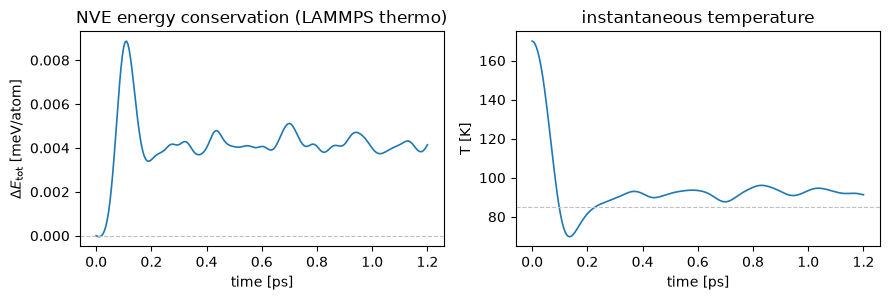
max |E_tot(t) - E_tot(0)| = 0.009 meV/atom over 1.2 ps | <T> (last half) = 92.5 K
Loop time of 76.717 on 1 procs for 240 steps with 400 atoms
Performance: 1.351 ns/day, 17.759 hours/ns, 3.128 timesteps/s, 1.251 katom-step/s
5. Validate against direct evaluation#
The step-0 state is exactly the wrapped frame we wrote to data.argon (velocity create does not move atoms), so LAMMPS’ first PotEng must equal a direct
XNNCalculator evaluation of that frame.
One subtlety, continuing the unit-constant story from the companion notebook: this coupling chains three codes’ conversion constants (the engine converts eV \(\rightarrow\) Hartree with CODATA 2018 values; LAMMPS converts Hartree \(\rightarrow\) eV using the MDI library’s own CODATA 2014-era factors). The net effect is a uniform scale factor of about \(8\times 10^{-9}\), i.e. agreement at the \(10^{-7}\) eV level instead of the companion’s \(10^{-14}\): unavoidable between independent codes, physically irrelevant, and harmless to the dynamics (a conservative potential scaled by a constant is still conservative).
The pressure decomposition also checks the MDI stress-sign convention end to end:
LAMMPS’ reported pressure must equal its own kinetic term plus the virial term from the
engine’s <STRESS.
torch.set_default_dtype(torch.float64)
from ase import units as u
from xnn.common.models import build_model, ForceStressOutput
from xnn.common.deploy import XNNCalculator

ckpt = torch.load(CKPT, map_location="cpu", weights_only=False)
model = ForceStressOutput(build_model(ckpt["cfg"].model), compute_stress=True).double()
model.load_state_dict(ckpt["model"])
at.calc = XNNCalculator(model, cutoff=ckpt["cfg"].model.cutoff, device=DEVICE)

e_dir = at.get_potential_energy()
p_virial = -at.get_stress()[:3].mean() / u.bar
p_kin = 2 * ke[0] / (3 * at.get_volume()) / u.bar     # from LAMMPS' own KinEng

print(f"step-0 PotEng: LAMMPS {pe[0]:.10f} eV | direct {e_dir:.10f} eV | "
      f"diff {abs(pe[0] - e_dir):.1e} eV ({abs(pe[0] - e_dir) / abs(e_dir):.1e} relative)")
print(f"step-0 Press : LAMMPS {press[0]:.2f} bar | "
      f"kinetic {p_kin:.2f} + virial {p_virial:.2f} = {p_kin + p_virial:.2f} bar")
assert abs(pe[0] - e_dir) < 1e-5
assert abs(press[0] - (p_kin + p_virial)) < 1.0
step-0 PotEng: LAMMPS -28.7660983948 eV | direct -28.7660986307 eV | diff 2.4e-07 eV (8.2e-09 relative)
step-0 Press : LAMMPS 793.33 bar | kinetic 606.37 + virial 186.96 = 793.33 bar
6. A driver-side observable: the Ar-Ar radial distribution function#
The RDF was accumulated by LAMMPS itself (compute rdf + fix ave/time, averaged
over the run) while the potential lived in the engine: the point of MDI coupling is that
the driver’s whole ecosystem keeps working. The curve shows the classic liquid-argon
structure: first coordination shell near 3.6 A, damped oscillations toward
\(g(r) \rightarrow 1\).
rdf = np.loadtxt(f"{RUN}/rdf.argon", skiprows=4)
r, g = rdf[:, 1], rdf[:, 2]

fig, ax = plt.subplots(figsize=(4.6, 3.1))
ax.plot(r, g, color="#1f77b4", lw=1.4)
ax.axhline(1, color="0.75", lw=0.8, ls="--")
ax.set_xlabel("r [A]"); ax.set_ylabel("g(r)")
ax.set_title("Ar-Ar radial distribution (LAMMPS, avg over 1.2 ps)")
plt.tight_layout(); plt.show()
print(f"first peak: r = {r[np.argmax(g)]:.2f} A, g = {g.max():.2f}")
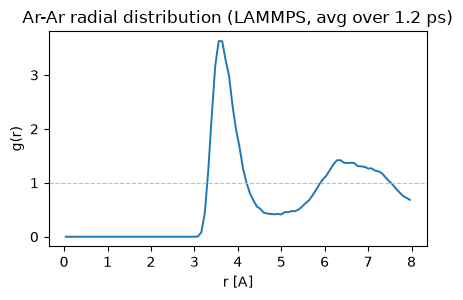
first peak: r = 3.56 A, g = 3.63
7. What the engine saw#
print("--- runs/mdi_argon_lammps/engine.log (tail) ---")
print("\n".join(open(f"{RUN}/engine.log").read().splitlines()[-5:]))
--- runs/mdi_argon_lammps/engine.log (tail) ---
INFO:__main__:MDI connection established
INFO:__main__:received 400 atoms, elements [18]
INFO:__main__:step 100: avg 150.1 ms/step
INFO:__main__:step 200: avg 108.9 ms/step
INFO:__main__:engine finished: 241 calculations, avg 102.1 ms/step
Where to go from here#
Production launch. TCP was convenient for a notebook; on a cluster run both codes
under one mpirun with the MPI method (mpi4py required on the engine side):
mpirun -np 1 xnn mdi --ckpt runs/mdi_argon/best.pt --device cuda:0 --dtype float64 \
        -mdi "-role ENGINE -name xnn -method MPI" \
    : -np 4 lmp -mdi "-role DRIVER -name LAMMPS -method MPI" -in in.argon
Anything LAMMPS can drive, the engine can serve. Swap fix nve for NPT, add more
fixes/computes, or use fix mdi/qm in hybrid QM/MM-style setups; on the xnn side,
point --ckpt at any family’s best.pt (NequIP, Allegro, CACE, SchNet, ANI, PhysNet,
BAMBOO, with or without LES). The protocol details of what travels over the wire are in
the companion notebook mdi_argon_md.ipynb.