
OPLS-AA conformational energetics: reproducing Table 1 of Jorgensen et al. (1996)#
The OPLS all-atom force field (Jorgensen, Maxwell & Tirado-Rives, J. Am.
Chem. Soc. 118, 11225, 1996) was parameterized so that relaxed torsional
energy profiles match RHF/6-31G* ab initio scans — Table 1 of the paper
lists the resulting relative conformer energies for hydrocarbons and
alcohols. Those numbers are the cleanest published fingerprint of the force
field, so this notebook reproduces them with the xnn OPLS implementation:
build small molecules (ethane, propane, butane, methanol, ethanol) from coordinates alone — atom types are assigned from the SMARTS templates of the parameter file and angles, dihedrals, 1,2/1,3 exclusions and scaled 1,4 pairs are derived from the perceived bonds;
run the paper’s dihedral driver: constrain one dihedral, relax every other internal degree of freedom (ASE
BFGS+FixInternalson top ofXNNCalculator);compare with Table 1.
Two parameter sets shipped with xnn (SEAMM .frc force-field files) are
used: oplsaa-1996, which restores the torsions of the original paper
(alkanes from Supporting Information Table 7, plus the H-C-O-H and
C-C-C-O alcohol terms), and oplsaa, the OPLS-AA distribution, whose
alkane torsions were mildly revised by the Jorgensen lab in late 1999 and
whose H-C-O-H term (V3 = 0.352 vs 0.45 kcal/mol) was revised later. The
former reproduces Table 1 essentially exactly; the latter shows what modern
OPLS-AA packages actually ship.
0. Setup#
import warnings
warnings.filterwarnings("ignore")
import math
import numpy as np
import torch
import matplotlib.pyplot as plt

torch.set_default_dtype(torch.float64)   # cheap for a classical force field
torch.manual_seed(0)
rng = np.random.default_rng(0)

from ase import Atoms
from ase.constraints import FixInternals
from ase.optimize import BFGS

import xnn
from xnn.common.deploy import XNNCalculator
from xnn.common.models import ForceStressOutput
from xnn.ffnn.models import OPLS, builtin_library
from xnn.ffnn.models.oplslib import KCAL_TO_EV

EV_TO_KCAL = 1.0 / KCAL_TO_EV
print("xnn:", xnn.__version__, "| torch:", torch.__version__)
xnn: 0.1.0 | torch: 2.5.1+cu121
1. Molecules and topologies#
OPLS.from_atoms builds the fixed topology from a structure: the per-atom
OPLS type names are assigned from the SMARTS templates carried by the
parameter file (so the file’s own numbering, opls_80 for an alkane CH3
carbon and so on, never has to be spelled out), the bonds are given
explicitly here (the geometry builder knows them; they can equally be
perceived from the coordinates), and everything else — angles, proper
dihedrals, nonbonded exclusions, scaled 1,4 pairs — is derived. The
geometries below are rough by intention: the force field relaxes them itself
before any scan.
def ideal_alkane(n, seed=42):
    """A rough all-anti alkane C_nH_{2n+2}: zig-zag backbone + jittered H."""
    r, ang = 1.529, math.radians(112.7)
    pos = [np.zeros(3)]
    up = True
    for _ in range(1, n):
        v = np.array([math.cos(ang / 2), (1 if up else -1) * math.sin(ang / 2), 0.0])
        pos.append(pos[-1] + r * v)
        up = not up
    jit = np.random.default_rng(seed)
    H, hb = [], []
    for i, p in enumerate(pos):
        for k in range(3 if i in (0, n - 1) else 2):
            phi = 2 * math.pi * k / 3 + 0.5 * i
            H.append(p + 1.09 * np.array([0.3 * (-1 if i == 0 else 1 if i == n - 1 else 0),
                                          0.7 * math.cos(phi), 0.9 * math.sin(phi)])
                     + 0.05 * jit.standard_normal(3))
            hb.append(i)
    z = [6] * n + [1] * len(H)
    bonds = [(i, i + 1) for i in range(n - 1)] + [(hb[k], n + k) for k in range(len(H))]
    return np.array(list(pos) + H), z, bonds, hb


# ethane / propane / butane: coordinates, atomic numbers and bonds only --
# the OPLS atom types come from the parameter file's SMARTS templates
molecules = {}
for name, n in (("ethane", 2), ("propane", 3), ("butane", 4)):
    pos, z, bonds, hb = ideal_alkane(n)
    molecules[name] = (pos, z, bonds)

# methanol
molecules["methanol"] = (
    np.array([[0.0, 0.0, 0.0], [1.41, 0.0, 0.0],
              [-0.36, -0.51, 0.89], [-0.36, -0.51, -0.89], [-0.36, 1.02, 0.0],
              [1.75, 0.4, 0.75]]),
    [6, 8, 1, 1, 1, 1],
    [(0, 1), (0, 2), (0, 3), (0, 4), (1, 5)])

# ethanol
molecules["ethanol"] = (
    np.array([[0.0, 0.0, 0.0], [1.512, 0.0, 0.0], [2.0, 1.32, 0.0],
              [-0.39, -0.51, 0.89], [-0.39, -0.51, -0.89], [-0.39, 1.02, 0.0],
              [1.90, -0.52, 0.88], [1.90, -0.52, -0.88], [2.60, 1.30, 0.7]]),
    [6, 6, 8, 1, 1, 1, 1, 1, 1],
    [(0, 1), (1, 2), (0, 3), (0, 4), (0, 5), (1, 6), (1, 7), (2, 8)])

# butane bookkeeping, exactly as counted in the paper:
# "In butane, for example, there are 27 dihedrals: 1 C-C-C-C, 10 H-C-C-C,
#  and 16 H-C-C-H."
pos, z, bonds = molecules["butane"]
top = OPLS.from_atoms((pos, z), "oplsaa", bonds=bonds).topology
print("butane atom types from the templates:", sorted(set(top.types)))
print(f"butane: {len(top.bonds)} bonds, {len(top.angles)} angles, "
      f"{len(top.dihedrals)} dihedrals, {len(top.pairs14)} 1,4 pairs")
butane atom types from the templates: ['opls_80', 'opls_81', 'opls_85']
butane: 13 bonds, 24 angles, 27 dihedrals, 27 1,4 pairs
2. The relaxed dihedral driver#
The paper’s BOSS dihedral driver fixes one dihedral and minimizes everything
else. Here that is ASE BFGS with a FixInternals constraint on top of
XNNCalculator(ForceStressOutput(OPLS(...))) — the forces are exact
autograd derivatives of the OPLS energy.
One practical detail: a perfectly eclipsed methyl group is a symmetric saddle point with zero net torque, and a gradient optimizer started exactly there will converge to it. A tiny random rattle before each minimization breaks the symmetry.
def fragment(bonds, n, axis_a, axis_b):
    """Atoms on the axis_b side of the bond axis_a-axis_b."""
    nbr = {i: set() for i in range(n)}
    for i, j in bonds:
        nbr[i].add(j); nbr[j].add(i)
    seen, stack, frag = {axis_a, axis_b}, [x for x in nbr[axis_b] if x != axis_a], set()
    while stack:
        x = stack.pop()
        if x in seen:
            continue
        seen.add(x); frag.add(x)
        stack.extend(nbr[x] - seen)
    return sorted(frag)


def relaxed_scan(molecule, dihedral, angles_deg, library, fmax=1e-5):
    """Constrained-dihedral relaxed energies (kcal/mol, relative)."""
    pos, z, bonds = molecule
    # SMARTS-typed against the library, topology from the given bonds
    model = OPLS.from_atoms((pos, z), library, bonds=bonds, cutoff=50.0)
    calc = lambda: XNNCalculator(ForceStressOutput(model), cutoff=model.cutoff)
    frag = fragment(bonds, len(z), dihedral[1], dihedral[2])
    ref = Atoms(numbers=z, positions=pos + 0.03 * rng.standard_normal((len(z), 3)))
    ref.calc = calc()
    BFGS(ref, logfile=None).run(fmax=fmax, steps=5000)   # free minimum
    energies = {}
    for a in angles_deg:
        w = ref.copy(); w.calc = calc()
        w.set_dihedral(*dihedral, a, indices=frag)
        w.rattle(0.004, seed=2)                          # break saddle symmetry
        w.set_constraint(FixInternals(dihedrals_deg=[[a, list(dihedral)]]))
        BFGS(w, logfile=None).run(fmax=fmax, steps=5000)
        energies[a] = w.get_potential_energy() * EV_TO_KCAL
    e0 = min(energies.values())
    return {a: e - e0 for a, e in energies.items()}
3. Table 1, recomputed#
Every scan below uses oplsaa-1996. The paper’s values are quoted next to
ours (kcal/mol).
lib96 = builtin_library("oplsaa-1996")

# (molecule, dihedral atoms, scan angles, paper reference values)
cases = [
    ("ethane",   "H-C-C-H", (2, 0, 1, 5), {60: 0.00, 0: 3.01}),
    ("propane",  "H-C-C-C", (8, 2, 1, 0), {60: 0.00, 0: 3.34}),
    ("butane",   "C-C-C-C", (0, 1, 2, 3), {180: 0.00, 120: 3.68, 60: 1.18, 0: 6.04}),
    ("methanol", "H-C-O-H", (2, 0, 1, 5), {60: 0.00, 0: 1.36}),
    ("ethanol",  "C-C-O-H", (0, 1, 2, 8), {180: 0.00, 120: 1.32, 60: 0.09, 0: 1.76}),
    ("ethanol",  "H-C-C-O", (3, 0, 1, 2), {60: 0.00, 0: 3.64}),
]
# paper values for butane/ethanol quote the 6-31G* column where OPLS-AA and
# 6-31G* differ; Table 1's OPLS-AA column is what we compare against:
paper_opls = {
    ("ethane", "H-C-C-H"): {60: 0.00, 0: 3.01},
    ("propane", "H-C-C-C"): {60: 0.00, 0: 3.32},
    ("butane", "C-C-C-C"): {180: 0.00, 120: 3.68, 60: 1.18, 0: 6.04},
    ("methanol", "H-C-O-H"): {60: 0.00, 0: 1.36},
    ("ethanol", "C-C-O-H"): {180: 0.00, 120: 1.32, 60: 0.09, 0: 1.76},
    ("ethanol", "H-C-C-O"): {60: 0.00, 0: 3.67},
}

print(f"{'molecule':<10} {'dihedral':<9} {'conf':>5} {'xnn':>7} {'paper':>7} {'diff':>7}")
worst = 0.0
for name, label, dih, angles in cases:
    res = relaxed_scan(molecules[name], dih, list(angles), lib96)
    ref = paper_opls[(name, label)]
    for a in angles:
        diff = res[a] - ref[a]
        worst = max(worst, abs(diff))
        print(f"{name:<10} {label:<9} {a:>5} {res[a]:>7.2f} {ref[a]:>7.2f} {diff:>+7.2f}")
print(f"\nlargest |deviation| from Table 1: {worst:.3f} kcal/mol")
assert worst < 0.05, "Table 1 is not reproduced"
molecule   dihedral   conf    xnn   paper    diff
ethane     H-C-C-H      60    0.00    0.00   +0.00
ethane     H-C-C-H       0    3.01    3.01   -0.00
propane    H-C-C-C      60    0.00    0.00   +0.00
propane    H-C-C-C       0    3.32    3.32   +0.00
butane     C-C-C-C     180    0.00    0.00   +0.00
butane     C-C-C-C     120    3.68    3.68   -0.00
butane     C-C-C-C      60    1.18    1.18   +0.00
butane     C-C-C-C       0    6.03    6.04   -0.01
methanol   H-C-O-H      60    0.00    0.00   +0.00
methanol   H-C-O-H       0    1.36    1.36   +0.00
ethanol    C-C-O-H     180    0.00    0.00   +0.00
ethanol    C-C-O-H     120    1.32    1.32   -0.00
ethanol    C-C-O-H      60    0.09    0.09   +0.00
ethanol    C-C-O-H       0    1.76    1.76   +0.00
ethanol    H-C-C-O      60    0.00    0.00   +0.00
ethanol    H-C-C-O       0    3.70    3.67   +0.03

largest |deviation| from Table 1: 0.026 kcal/mol
Every entry agrees with the paper’s OPLS-AA column to a few hundredths of a kcal/mol — the residuals are the finite convergence of the scans, not the force field.
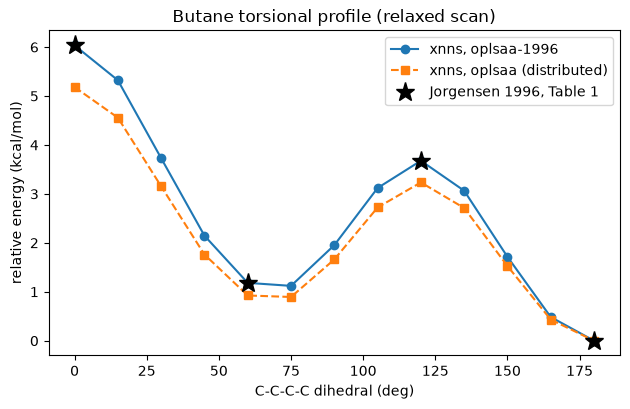
4. The full butane profile: 1996 torsions vs the modern distribution#
The late-1999 revision softened the three alkane torsions slightly
(C-C-C-C, i.e. the opls_18 quadruple in the file: V = 1.740/-0.157/0.279
→ 1.300/-0.050/0.200 kcal/mol, H-C-C-H: 0.318 → 0.300, H-C-C-C: 0.366 →
0.300); its gauche-trans gap is ~0.25 kcal/mol smaller. Both are “OPLS-AA” in the wild, which is worth
knowing when comparing against other codes.
angles = list(range(0, 181, 15))
prof96 = relaxed_scan(molecules["butane"], (0, 1, 2, 3), angles, lib96)
profd = relaxed_scan(molecules["butane"], (0, 1, 2, 3), angles,
                     builtin_library("oplsaa"))
paper_pts = {0: 6.04, 60: 1.18, 120: 3.68, 180: 0.00}

fig, ax = plt.subplots(figsize=(6.4, 4.2))
ax.plot(angles, [prof96[a] for a in angles], "o-", label="xnn, oplsaa-1996")
ax.plot(angles, [profd[a] for a in angles], "s--",
        label="xnn, oplsaa (distributed)")
ax.plot(list(paper_pts), list(paper_pts.values()), "k*", ms=14,
        label="Jorgensen 1996, Table 1")
ax.set_xlabel("C-C-C-C dihedral (deg)")
ax.set_ylabel("relative energy (kcal/mol)")
ax.set_title("Butane torsional profile (relaxed scan)")
ax.legend()
fig.tight_layout()
fig.savefig("opls_butane_profile.png", dpi=150)
plt.show()
Summary#
MolecularTopology+ a built-in library is all it takes to evaluate OPLS energies with autograd forces; the dihedral driver is ~20 lines of ASE.With the original 1996 alkane torsions (
oplsaa-1996), Table 1 of the paper is reproduced to a few hundredths of a kcal/mol across ethane, propane, butane, methanol and ethanol — the alcohol torsions of the standard distribution are unchanged since 1996 and match exactly.The distributed OPLS-AA alkane torsions (late-1999 revision) give a slightly softer butane profile; both variants ship as built-ins.
The OpenMM cross-validation of the full functional form lives in
examples/fidelity_checks/opls_verification.ipynb; refitting torsions by
gradient descent is demonstrated in opls_lopls_torsion_refit.ipynb.