
Training ANI from scratch on rMD17 (paracetamol)#
This trains the xnn ANI model, the AEV descriptor of Smith et al.
(Chem. Sci. 2017) feeding one neural network per element, from scratch on a
real H/C/N/O molecule, and reproduces the paper’s headline demonstrations at
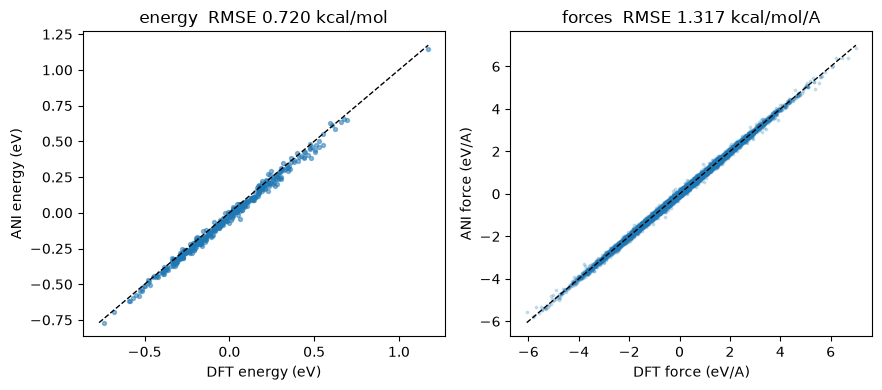
small scale:
an energy/force parity plot vs DFT (paper Fig. 4), and
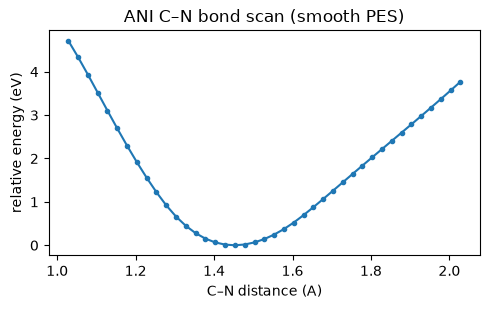
a smooth 1-D potential-energy scan (paper Fig. 7), the property that makes ANI usable for MD.
We use rMD17 paracetamol
(C₈H₉NO₂) because it exercises all four ANI elements and downloads in seconds
through the xnn hub. (The 20 M-conformation ANI-1 training set itself is also
in the hub: load_dataset("ani1"); see ani1_dataset.ipynb.)
Run with the xnn kernel.
0. Setup and data#
import time, warnings
warnings.filterwarnings("ignore")
import numpy as np
import torch
import matplotlib.pyplot as plt

torch.set_default_dtype(torch.float64)
torch.manual_seed(0)

from xnn.common.data import load_dataset

CUTOFF = 5.2                       # ANI-1x radial cutoff (>= angular 3.5)
splits = load_dataset("rmd17", molecule="paracetamol",
                      n_train=1000, n_test=400, cutoff=None)
train_structs, test_structs = splits["train"], splits["test"]
print(f"train {len(train_structs)}  test {len(test_structs)}")
Z0 = train_structs[0]["atomic_numbers"]
print("elements:", sorted(set(int(z) for z in Z0)), " atoms/mol:", len(Z0))
train 1000  test 400
elements: [1, 6, 7, 8]  atoms/mol: 20
1. Self atomic energies (ANI’s EnergyShifter)#
ANI predicts the energy relative to per-element self energies, fit here by least squares \(E \approx \sum_Z n_Z\,e_Z\) and subtracted from the targets. The network then learns the small residual, the chemically interesting part, which also keeps the fit numerically well conditioned.
SPECIES = [1, 6, 7, 8]
counts = np.array([[np.sum(s["atomic_numbers"] == z) for z in SPECIES]
                   for s in train_structs], dtype=float)
E_train = np.array([s["energy"] for s in train_structs])
sae, *_ = np.linalg.lstsq(counts, E_train, rcond=None)
print("self energies (eV):", {z: round(float(e), 3) for z, e in zip(SPECIES, sae)})

def subtract_sae(structs):
    for s in structs:
        n = np.array([np.sum(s["atomic_numbers"] == z) for z in SPECIES])
        s["energy"] = float(s["energy"] - n @ sae)

subtract_sae(train_structs); subtract_sae(test_structs)
resid = np.array([s["energy"] for s in train_structs])
print(f"residual energy: mean {resid.mean():.3f} eV  std {resid.std():.3f} eV")
self energies (eV): {1: -839.943, 6: -746.616, 7: -93.327, 8: -186.654}
residual energy: mean -0.000 eV  std 0.271 eV
2. Build the ANI model and train#
We use the ANI-1x AEV grid (384-length) with a compact per-element MLP and the
CELU activation, trained on energies and forces (forces come for free via
autograd through the ForceStressOutput wrapper the Trainer adds).
from torch.utils.data import Subset
from xnn.common.data import AtomicDataset
from xnn.common.config import Config, ModelConfig, DataConfig, OptimConfig
from xnn.common.train import Trainer

EPOCHS, BS, LR = 80, 32, 1e-3

train_ds = AtomicDataset(train_structs, CUTOFF)
test_ds = AtomicDataset(test_structs, CUTOFF)
n_val = 100
val_idx = list(range(n_val))
tr_idx = list(range(n_val, len(train_ds)))

cfg = Config(
    model=ModelConfig(name="ani", cutoff=CUTOFF,
                      extra={"species": SPECIES, "hidden": [128, 128, 64],
                             "activation": "celu"}),
    data=DataConfig(cutoff=CUTOFF, batch_size=BS),
    optim=OptimConfig(lr=LR, epochs=EPOCHS, energy_weight=1.0,
                      force_weight=10.0, scheduler="plateau"),
    output_dir="runs/ani_rmd17",
)

trainer = Trainer(cfg, Subset(train_ds, tr_idx), Subset(train_ds, val_idx), test_ds)
n_params = sum(p.numel() for p in trainer.module.parameters())
print(f"ANI parameters: {n_params:,}  |  device: {trainer.device}")

hist = {"train": [], "val": []}
trainer._log = lambda ep, tr, va: (hist["train"].append(tr.get("loss")),
                                   hist["val"].append(va.get("loss")))
t0 = time.time()
metrics = trainer.fit()
print(f"trained {EPOCHS} epochs in {time.time()-t0:.1f}s | test loss {metrics['test']['loss']:.4e}")
ANI parameters: 296,452  |  device: cuda
test loss 3.2432e-02
trained 80 epochs in 177.5s | test loss 3.2432e-02
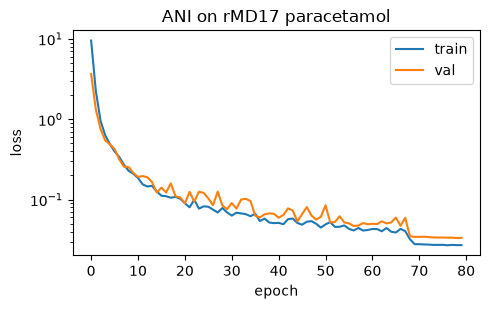
3. Learning curves#
fig, ax = plt.subplots(figsize=(5, 3.2))
ax.plot(hist["train"], label="train")
ax.plot(hist["val"], label="val")
ax.set_yscale("log"); ax.set_xlabel("epoch"); ax.set_ylabel("loss")
ax.set_title("ANI on rMD17 paracetamol"); ax.legend(); fig.tight_layout()
fig.savefig("ani_loss_curves.png", dpi=110); plt.show()
4. Energy & force parity vs DFT (paper Fig. 4)#
Predict on the held-out test set and compare to reference DFT. We report the energy RMSE in meV and kcal/mol (the paper’s unit).
from torch.utils.data import DataLoader
from xnn.common.data import collate

model = trainer.model.eval()
device = trainer.device
EV2KCAL = 23.060541945329334

E_pred, E_ref, F_pred, F_ref = [], [], [], []
loader = DataLoader(test_ds, batch_size=32, collate_fn=collate)
for batch in loader:
    batch = batch.to(device)
    out = model(batch)
    E_pred.append(out["energy"].detach().cpu().numpy())
    E_ref.append(batch.energy.detach().cpu().numpy())
    F_pred.append(out["forces"].detach().cpu().numpy())
    F_ref.append(batch.forces.detach().cpu().numpy())
E_pred, E_ref = np.concatenate(E_pred), np.concatenate(E_ref)
F_pred, F_ref = np.concatenate(F_pred), np.concatenate(F_ref)

e_rmse = np.sqrt(np.mean((E_pred - E_ref) ** 2))
f_rmse = np.sqrt(np.mean((F_pred - F_ref) ** 2))
print(f"energy RMSE: {e_rmse*1e3:.2f} meV  ({e_rmse*EV2KCAL:.3f} kcal/mol)")
print(f"force  RMSE: {f_rmse*1e3:.1f} meV/A  ({f_rmse*EV2KCAL:.3f} kcal/mol/A)")

fig, (a1, a2) = plt.subplots(1, 2, figsize=(9, 4))
a1.scatter(E_ref, E_pred, s=8, alpha=0.5)
lim = [min(E_ref.min(), E_pred.min()), max(E_ref.max(), E_pred.max())]
a1.plot(lim, lim, "k--", lw=1)
a1.set_xlabel("DFT energy (eV)"); a1.set_ylabel("ANI energy (eV)")
a1.set_title(f"energy  RMSE {e_rmse*EV2KCAL:.3f} kcal/mol")
a2.scatter(F_ref.ravel(), F_pred.ravel(), s=3, alpha=0.2)
lim = [F_ref.min(), F_ref.max()]
a2.plot(lim, lim, "k--", lw=1)
a2.set_xlabel("DFT force (eV/A)"); a2.set_ylabel("ANI force (eV/A)")
a2.set_title(f"forces  RMSE {f_rmse*EV2KCAL:.3f} kcal/mol/A")
fig.tight_layout(); fig.savefig("ani_parity.png", dpi=110); plt.show()
energy RMSE: 31.23 meV  (0.720 kcal/mol)
force  RMSE: 57.1 meV/A  (1.317 kcal/mol/A)
5. A smooth 1-D potential-energy scan (paper Fig. 7)#
The value of ANI over semi-empirical methods is a smooth, differentiable surface. We take a test geometry and stretch its first C–N bond, evaluating the trained ANI energy along the scan. A smooth, single-well curve (not a jagged one) is what enables stable MD.
from xnn.common.data.neighborlist import build_neighbor_list
from xnn.common.data import AtomicGraph

s = test_structs[0]
Z = torch.tensor(s["atomic_numbers"], dtype=torch.long)
pos0 = torch.tensor(s["pos"], dtype=torch.float64)

# pick a C(6)-N(7) bonded pair
Cs = (Z == 6).nonzero().flatten(); N = (Z == 7).nonzero().flatten()[0]
d = torch.linalg.norm(pos0[Cs] - pos0[N], dim=1)
i, j = int(Cs[d.argmin()]), int(N)          # closest C to the N
axis = (pos0[j] - pos0[i]); axis = axis / axis.norm()
r0 = torch.linalg.norm(pos0[j] - pos0[i]).item()

scan = np.linspace(-0.4, 0.6, 41)
energies = []
for dr in scan:
    pos = pos0.clone(); pos[j] = pos[j] + dr * axis
    ei, cs = build_neighbor_list(pos, CUTOFF)
    g = AtomicGraph(pos=pos.to(device), atomic_numbers=Z.to(device),
                    edge_index=ei.to(device), cell_shifts=cs.to(device),
                    batch=torch.zeros(len(Z), dtype=torch.long, device=device),
                    n_atoms=torch.tensor([len(Z)], device=device))
    with torch.no_grad():
        energies.append(model(g)["energy"].item())
energies = np.array(energies) - min(energies)

fig, ax = plt.subplots(figsize=(5, 3.2))
ax.plot(r0 + scan, energies, "o-", ms=3)
ax.set_xlabel("C–N distance (A)"); ax.set_ylabel("relative energy (eV)")
ax.set_title("ANI C–N bond scan (smooth PES)"); fig.tight_layout()
fig.savefig("ani_bond_scan.png", dpi=110); plt.show()
Summary#
From scratch on 900 paracetamol conformations, xnn ANI reaches chemical-scale
energy/force accuracy and produces a smooth potential-energy surface: the two
properties the ANI-1 paper emphasises. The same model, at full scale on the
load_dataset("ani1") training set and the published network widths
(ANI.ani1x()), is the ANI-1x potential verified element-for-element against
torchani in examples/fidelity_checks/ani_verification.ipynb.