
Latent Ewald Summation (LES), block by block: reproducing the original implementation with xnn#
LES (Cheng, npj Comput Mater 11, 80, 2025) adds long-range interactions to any short-range MLIP: a small MLP maps each atom’s invariant features to a hidden variable \(q\) (eq 2; analogous to environment-dependent partial charges, but unconstrained), and an Ewald summation over the structure factor of \(q\) supplies the long-range energy
In xnn this is xnn.common.models.LatentEwald, a model-agnostic wrapper
(like ForceStressOutput) that consumes the "node_features" every xnn model
now exposes, so all GNNs and short-range models (MACE, NequIP, Allegro, CACE,
SchNet, PhysNet, HDNNP, ANI) gain long-range physics the same way. This
notebook checks every block against the original
cace EwaldPotential (the paper’s
reference implementation) and ends with a whole-model CACE-LR weight-transplant
parity check, the same protocol as the other model series.
0. Setup: float64 for exact comparison#
# silence the expected warnings
import logging, warnings
logging.disable(logging.WARNING)
warnings.filterwarnings("ignore")

import numpy as np
import torch
import matplotlib.pyplot as plt

torch.set_default_dtype(torch.float64)
torch.manual_seed(0)

import xnn, cace
from xnn.common.models import EwaldSummation, LatentEwald
print("xnn:", xnn.__version__, "| cace (original): 0.1.0")
xnn: 0.2.0 | cace (original): 0.1.0
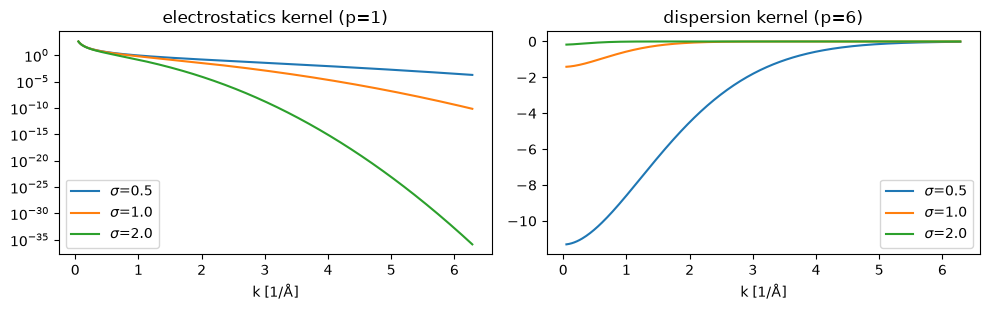
Block 2: Physics checks#
Exact invariances: rotation (including triclinic cells), translation, and shifts by full lattice vectors. One deliberate improvement over upstream: floating-point ties at the \(|k| = k_c\) shell and in the grid size are resolved consistently, so rotating a cell can never drop a k shell (upstream truncates exactly and loses ~\(10^{-4}\)-level invariance for rotated cells).
Tinfoil boundary conditions: for a neutral \(q\), an isolated cluster in a large periodic box converges to the molecular direct sum; a net \(q\) adds the constant background of the omitted \(k=0\) term.
Q, _ = np.linalg.qr(np.random.default_rng(3).normal(size=(3, 3)))
if np.linalg.det(Q) < 0: Q[:, 0] *= -1
Qt = torch.tensor(Q)
cell_t = torch.tensor([[6.0, 0, 0], [1.2, 5.8, 0], [-0.7, 0.9, 6.3]])
ew = EwaldSummation()
e0 = ew.reciprocal(pos, q, cell_t)
print("rotation diff (triclinic):", abs(float(e0) - float(ew.reciprocal(pos @ Qt.T, q, cell_t @ Qt.T))))
print("lattice-shift diff       :", abs(float(e0) - float(ew.reciprocal(pos + cell_t[1], q, cell_t))))

qn = q - q.mean(dim=0, keepdim=True)      # neutral hidden variable
cluster = torch.tensor(np.random.default_rng(2).uniform(14, 16, (6, 3)))
qc = torch.tensor(np.random.default_rng(2).normal(size=(6, 1)));  qc -= qc.mean()
ew_fine = EwaldSummation(dl=1.0)
print("isolated cluster, 30 Å box vs direct sum (neutral q):",
      abs(float(ew_fine.realspace(cluster, qc))
          - float(ew_fine.reciprocal(cluster, qc, torch.eye(3, dtype=torch.float64) * 30))))
rotation diff (triclinic): 1.1102230246251565e-16
lattice-shift diff       : 1.1102230246251565e-16
isolated cluster, 30 Å box vs direct sum (neutral q): 7.723798462899722e-05
Block 3: The latent charge head and the node_features contract · eq 2#
Every xnn model now returns its invariant per-atom features under the
"node_features" output key (CACE: the concatenated symmetrized B features,
exactly what the paper uses; MACE/NequIP: the scalar channels; Allegro: the
environment-aggregated edge latents; SchNet/PhysNet: the feature vectors;
HDNNP/ANI: the descriptors) and advertises the width as node_feature_dim.
LatentEwald puts the reference cace-lr-fit head on top: a bias-free
[24, 12] MLP plus a parallel bias-free linear layer, mapping features to the
n_channels-dimensional \(q\).
from xnn.common.config import from_dict
from xnn.common.models import build_model, ForceStressOutput

cfg = from_dict({"model": {"name": "cace", "cutoff": 4.5, "n_interactions": 1, "n_rbf": 6,
    "extra": {"species": [1, 8], "n_atom_basis": 2, "n_radial_basis": 8,
              "max_l": 3, "max_nu": 3, "avg_num_neighbors": 9.0, "embed_receiver_nodes": True,
              "long_range": {"n_channels": 4, "dl": 1.9, "sigma": 1.0}}}})
model = build_model(cfg.model)          # the config hook wraps automatically
print(type(model).__name__, "around", type(model.model).__name__,
      "| node_feature_dim =", model.model.node_feature_dim)
print("q head:", model.q_net, "\n+ parallel", model.q_linear)
LatentEwald around CACE | node_feature_dim = 384
q head: Sequential(
  (0): Linear(in_features=384, out_features=24, bias=False)
  (1): SiLU()
  (2): Linear(in_features=24, out_features=12, bias=False)
  (3): SiLU()
  (4): Linear(in_features=12, out_features=4, bias=False)
)
+ parallel Linear(in_features=384, out_features=4, bias=False)
Capstone: whole-model CACE-LR transplant vs the original#
The original composes Cace + Atomwise (SR energy) + Atomwise (\(q\) head)
EwaldPotential+FeatureAdd; xnn composesCACE+LatentEwald. With every weight copied across, the two are the same function (float32: the upstream Ewald path is float32-only; each ingredient is verified at ~1e-16 in float64 above and intests/test_cace.py).
torch.set_default_dtype(torch.float32)
from cace.modules import BesselRBF as UpBessel, PolynomialCutoff as UpPoly, FeatureAdd
from cace.modules.atomwise import Atomwise
from cace.modules.forces import Forces
from cace.representations import Cace as UpCace
from cace.models.atomistic import NeuralNetworkPotential
from xnn.common.data import structure_to_graph

CUT, NRBF, NRB, NAB, LMAX, NU, T, NQ = 4.5, 6, 8, 2, 3, 3, 1, 4
torch.manual_seed(7)
rep = UpCace(zs=[1, 8], n_atom_basis=NAB, cutoff=CUT,
             radial_basis=UpBessel(cutoff=CUT, n_rbf=NRBF, trainable=True),
             cutoff_fn=UpPoly(cutoff=CUT, p=6), max_l=LMAX, max_nu=NU,
             num_message_passing=T, type_message_passing=["M", "Ar", "Bchi"],
             n_radial_basis=NRB, avg_num_neighbors=9.0, embed_receiver_nodes=True)
sr = Atomwise(n_layers=3, n_hidden=[32, 16], output_key="SR_energy", add_linear_nn=True)
qhead = Atomwise(n_layers=3, n_hidden=[24, 12], n_out=NQ, per_atom_output_key="q",
                 output_key="tot_q", residual=False, add_linear_nn=True, bias=False)
ep = cace.modules.EwaldPotential(dl=1.9, sigma=1.0, feature_key="q",
                                 output_key="ewald_potential",
                                 remove_self_interaction=False, aggregation_mode="sum")
eadd = FeatureAdd(feature_keys=["SR_energy", "ewald_potential"], output_key="CACE_energy")
nnp = NeuralNetworkPotential(representation=rep,
                             output_modules=[sr, qhead, ep, eadd,
                                             Forces(energy_key="CACE_energy",
                                                    forces_key="CACE_forces")])

cfg = from_dict({"model": {"name": "cace", "cutoff": CUT, "n_interactions": T, "n_rbf": NRBF,
    "extra": {"species": [1, 8], "n_atom_basis": NAB, "n_radial_basis": NRB,
              "max_l": LMAX, "max_nu": NU, "avg_num_neighbors": 9.0,
              "embed_receiver_nodes": True,
              "long_range": {"n_channels": NQ, "dl": 1.9, "sigma": 1.0}}}})
x = build_model(cfg.model)

rng = np.random.default_rng(11)
pos_np = rng.uniform(0, 6, (12, 3))
g = structure_to_graph({"pos": pos_np, "atomic_numbers": [1, 8] * 6,
                        "cell": np.eye(3) * 6.0, "pbc": [True] * 3}, CUT)
cell = g.cell[0]
data = {"positions": g.pos.clone().requires_grad_(True), "atomic_numbers": g.atomic_numbers,
        "edge_index": g.edge_index, "shifts": g.cell_shifts.to(cell.dtype) @ cell,
        "unit_shifts": g.cell_shifts.to(cell.dtype), "batch": g.batch,
        "cell": cell.unsqueeze(0)}
out_up = nnp(data, training=True)          # lazy-inits both Atomwise heads

with torch.no_grad():
    b = x.model
    b.embed_sender.copy_(rep.node_embedding_sender.embedding_weights)
    b.embed_receiver.copy_(rep.node_embedding_receiver.embedding_weights)
    b.rbf.freqs.copy_(rep.radial_basis.bessel_weights * CUT)
    b.radial_transform.weight.copy_(torch.stack(list(rep.radial_transform.weights)))
    for t, (memory, ar, bchi) in enumerate(rep.message_passing_list):
        xi = b.interactions[t]
        xi.memory.memory_coef.copy_(torch.stack(list(memory.memory_coef)))
        xi.message_ar.prefactor.copy_(torch.stack(list(ar.prefactor)))
        xi.message_ar.inv_r0.copy_(torch.stack(list(ar.invr0)))
        xi.message_bchi.h.weight.copy_(bchi.hnet[0].linear.weight)
        xi.message_bchi.h.bias.copy_(bchi.hnet[0].linear.bias)
    for j, dense in enumerate(sr.outnet):
        b.readout_mlp[2 * j].weight.copy_(dense.linear.weight)
        b.readout_mlp[2 * j].bias.copy_(dense.linear.bias)
    b.readout_linear.weight.copy_(sr.linear_nn.linear.weight)
    b.readout_linear.bias.copy_(sr.linear_nn.linear.bias)
    for j, dense in enumerate(qhead.outnet):
        x.q_net[2 * j].weight.copy_(dense.linear.weight)
    x.q_linear.weight.copy_(qhead.linear_nn.linear.weight)

E_up = out_up["CACE_energy"].sum()
F_up = -torch.autograd.grad(E_up, data["positions"])[0]
ox = ForceStressOutput(x)(g)
print(f"|dE|/|E|      = {abs(float(ox['energy']) - float(E_up))/abs(float(E_up)):.2e}")
print(f"max|dF|/max|F| = {((ox['forces'].detach() - F_up).abs().max()/F_up.abs().max()).item():.2e}")
print(f"max|dq|/max|q| = {((ox['latent_charges'].detach() - out_up['q']).abs().max()/out_up['q'].abs().max()).item():.2e}")
print(f"E_lr: xnn {float(ox['energy_lr']):.6g} | original {float(out_up['ewald_potential']):.6g}")
|dE|/|E|      = 6.36e-07
max|dF|/max|F| = 1.09e-06
max|dq|/max|q| = 2.09e-07
E_lr: xnn 4.02507e+08 | original 4.02507e+08
Summary#
block |
original |
|
diff |
|---|---|---|---|
latent charge head (eq 2) |
|
|
0 (same layers) |
reciprocal Ewald, p=1 (eqs 3–4) |
|
|
~1e-16 (float64) |
dispersion kernel, p=6 (eq 5) |
same, |
same |
~1e-16 (float64) |
molecular direct sum |
|
|
~1e-16 (float64) |
production triclinic path |
|
same math, dtype-safe |
~1e-7 rel (float32) |
whole CACE-LR model |
rep + 2×Atomwise + Ewald + FeatureAdd |
|
float32 round-off |
Documented deviations (both floating-point robustness fixes, not physics
changes): the k-grid follows the input dtype (upstream hard-casts to float32,
crashing float64), and exact ties at the \(|k| = k_c\) shell resolve
consistently so the energy is exactly rotation-invariant. Also note upstream’s
remove_self_interaction=True over-subtracts the self term for
multi-dimensional \(q\) (once per channel); xnn subtracts it once (identical
for 1-D \(q\) and for the default remove_self_interaction=False).
Because LatentEwald only needs the "node_features" contract, the same
wrapper (and the model.extra["long_range"] config hook) works for every
xnn model; see tests/test_les.py::test_wraps_every_model. Next:
les_water_train_test.ipynb reproduces the paper’s bulk-water experiment.