
PhysNet, block by block: reproducing the original implementation with xnn#
PhysNet (Unke & Meuwly, JCTC 15, 3678, 2019)
is a message-passing HDNN that predicts energies, forces, partial charges and
dipoles, with the physics (switched/shielded electrostatics of the predicted
charges and Grimme D3(BJ) dispersion) built into the energy expression. The
original implementation (MMunibas/PhysNet)
is TensorFlow 1.x; xnn.dnn.models.physnet is a pure-PyTorch translation on
the xnn abstractions. This notebook walks through every block and checks each
against the original TF graph on the same inputs, ending with a whole-model
weight transplant and an energy/force/charge parity check at machine precision,
the same protocol as the MACE / NequIP / Allegro / CACE companions.
The original only ever ran in float32. Three tiny harness patches (noted inline, none changing the math) let its graph run in float64 here so the comparison is at machine precision: dropout with
keep_prob=1is replaced by the identity, the RBF layer receives the model dtype (upstream forgets to forward it), and the activation’slog(2)constant is computed in float64.
0. Setup: TF1 compatibility mode + float64#
# silence the expected warnings / TF chatter
import logging, os, warnings
os.environ["TF_CPP_MIN_LOG_LEVEL"] = "3"
logging.disable(logging.WARNING)
warnings.filterwarnings("ignore")

import subprocess, sys, tempfile
import numpy as np

# ---- the original TF1 PhysNet (cloned on demand) ----
UPSTREAM = os.environ.get("PHYSNET_UPSTREAM_PATH",
                          os.path.join(tempfile.gettempdir(), "physnet-upstream"))
if not os.path.isdir(UPSTREAM):
    subprocess.run(["git", "clone", "--depth", "1",
                    "https://github.com/MMunibas/PhysNet", UPSTREAM], check=True)

import tensorflow.compat.v1 as tf
tf.disable_eager_execution()
tf.get_logger().setLevel("ERROR")
sys.modules["tensorflow"] = tf          # upstream modules do `import tensorflow as tf`
# upstream applies dropout with keep_prob = 1.0 (identity); its float32
# placeholder trips TF2's dtype check in float64 graphs
tf.nn.dropout = lambda x, keep_prob=None, **kw: x

sys.path.insert(0, UPSTREAM)
import neural_network.NeuralNetwork as _nnmod
from neural_network.NeuralNetwork import NeuralNetwork

# upstream forgets to forward dtype to RBFLayer (float32 hard-coded)
_OrigRBF = _nnmod.RBFLayer
_nnmod.RBFLayer = lambda K, cutoff, scope=None: _OrigRBF(K, cutoff, scope=scope, dtype=tf.float64)

import torch
torch.set_default_dtype(torch.float64)
import xnn
print("xnn:", xnn.__version__, "| tensorflow:", tf.__version__, "| torch:", torch.__version__)
xnn: 0.1.0 | tensorflow: 2.21.0 | torch: 2.12.1+cpu
A toy system#
A charged 8-atom H/C/O cluster with the full ordered pair list, upstream’s default molecular mode (no long-range cutoff), so every term including the un-damped electrostatics is exercised.
F_DIM, K, SR_CUT, NB, NRA, NRI, NRO = 24, 16, 4.0, 3, 2, 3, 1
Q_TOT = 1.0

rng = np.random.default_rng(7)
N = 8
R_np = rng.uniform(0, 3.5, (N, 3))
Z_np = np.array([8, 1, 1, 6, 1, 1, 1, 1])
idx_i = np.repeat(np.arange(N), N - 1)                                # centers
idx_j = np.concatenate([[j for j in range(N) if j != i] for i in range(N)])  # neighbors
print(f"{N} atoms, {len(idx_i)} ordered pairs, total charge {Q_TOT}")
8 atoms, 56 ordered pairs, total charge 1.0
The PhysNet architecture in one picture#
Embedding (eq 3): nuclear charges index a 95-row learnable table of \(F\)-vectors: every element up to Pu, no species list.
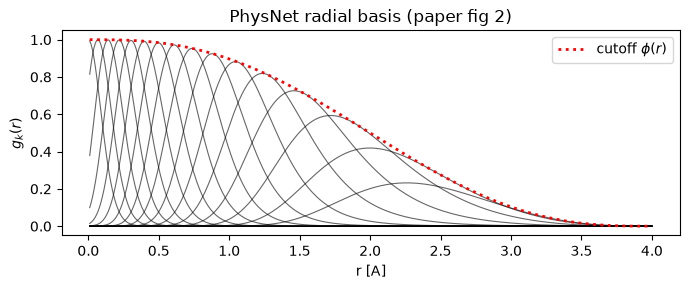
Radial basis (eqs 7–8): \(g_k(r) = \phi(r)\,e^{-\beta_k(e^{-r}-\mu_k)^2}\), learnable centers/widths (softplus-positive), smooth cutoff \(\phi\). The \(e^{-r}\) argument biases the learnable attention masks toward exponential decay; bound-state wave functions decay exponentially.
Modules (\(N_{\rm module}\) stacked): an interaction block computes the message \(v\) from gated features and the attention mask \(G\,g(r_{ij})\) (eqs 5–6) and refines atom-wise through pre-activation residual blocks (eq 4); an output block per module predicts \((E_i^m, q_i^m)\) through a zero-initialized head (eq 9).
Scale/shift (eq 10): module outputs are summed and scaled/shifted per element.
Charges → physics (eqs 12–14): charges are corrected to the exact total charge, then enter a shielded (\(1/\sqrt{r^2+1}\)), smoothstep-switched Coulomb term; D3(BJ) dispersion (with learnable \(s_6, s_8, a_1, a_2\)) completes the energy. Dipoles come from eq 15.
# --- build both models once; every block below compares their internals ---
act = lambda x: tf.nn.softplus(x) - np.log(2.0)   # float64-exact shifted softplus
nn = NeuralNetwork(F=F_DIM, K=K, sr_cut=SR_CUT, lr_cut=None, num_blocks=NB,
                   num_residual_atomic=NRA, num_residual_interaction=NRI,
                   num_residual_output=NRO, use_electrostatic=True,
                   use_dispersion=True, Eshift=0.1, Escale=1.3,
                   Qshift=0.01, Qscale=0.9, activation_fn=act,
                   dtype=tf.float64, scope="nn", seed=7)

Z_t = tf.constant(Z_np, tf.int32); R_t = tf.constant(R_np, tf.float64)
ii_t = tf.constant(idx_i, tf.int32); jj_t = tf.constant(idx_j, tf.int32)
Qt_t = tf.constant([Q_TOT], tf.float64)

Dij_op = nn.calculate_interatomic_distances(R_t, ii_t, jj_t)
rbf_op = nn.rbf_layer(Dij_op)
x0_op = tf.gather(nn.embeddings, Z_t)
xs_ops, outs_ops = [x0_op], []
for i in range(NB):
    xs_ops.append(nn.interaction_block[i](xs_ops[-1], rbf_op, ii_t, jj_t))
    outs_ops.append(nn.output_block[i](xs_ops[-1]))
Ea_op, Qa_raw_op, _, nh_op = nn.atomic_properties(Z_t, R_t, ii_t, jj_t)
Qa_op = nn.scaled_charges(Z_t, Qa_raw_op, Q_tot=Qt_t)
Eele_op = nn.electrostatic_energy_per_atom(Dij_op, Qa_op, ii_t, jj_t)
from neural_network.grimme_d3.grimme_d3 import edisp as tf_edisp, d3_autoang, d3_autoev
Edisp_op = d3_autoev * tf_edisp(Z_t, Dij_op / d3_autoang, ii_t, jj_t,
                                s6=nn.s6, s8=nn.s8, a1=nn.a1, a2=nn.a2)
E_op, F_op = nn.energy_and_forces(Z_t, R_t, ii_t, jj_t, Q_tot=Qt_t)

sess = tf.Session()
sess.run(tf.global_variables_initializer())
# the k2f and output heads are zero-initialized upstream (they would leave the
# network body unexercised) -- randomize them for a meaningful comparison
rng_w = np.random.default_rng(107)
for v in tf.global_variables():
    if "k2f/W" in v.name or "dense_layer/W" in v.name:
        sess.run(v.assign(0.2 * rng_w.standard_normal(v.shape.as_list())))
vals = {v.name: sess.run(v) for v in tf.global_variables()}

# ---- the xnn PhysNet, weights transplanted ----
from xnn.common.config import from_dict
from xnn.common.models import build_model, ForceStressOutput

cfg = from_dict({"model": {"name": "physnet", "cutoff": SR_CUT,
                           "n_features": F_DIM, "n_rbf": K, "n_interactions": NB,
                           "extra": {"num_residual_atomic": NRA,
                                     "num_residual_interaction": NRI,
                                     "num_residual_output": NRO}}})
x = build_model(cfg.model)

def transplant_tf_to_torch(x, vals, num_blocks, scope="nn"):
    """Copy every variable of the original TF PhysNet into the xnn PhysNet."""
    import torch
    def g(name): return torch.tensor(np.asarray(vals[f"{scope}/{name}:0"]))
    with torch.no_grad():
        x.embeddings.copy_(g("embeddings"))
        x.rbf_layer.centers.copy_(g("rbf_layer/centers"))
        x.rbf_layer.widths.copy_(g("rbf_layer/widths"))
        x.Eshift.copy_(g("Eshift")); x.Escale.copy_(g("Escale"))
        x.Qshift.copy_(g("Qshift")); x.Qscale.copy_(g("Qscale"))
        x._s6.copy_(g("s6")); x._s8.copy_(g("s8"))
        x._a1.copy_(g("a1")); x._a2.copy_(g("a2"))
        def cd(dst, sc, bias=True):
            dst.weight.copy_(g(f"{sc}/W"))
            if bias: dst.bias.copy_(g(f"{sc}/b"))
        def cr(dst, sc):
            cd(dst.dense, f"{sc}/dense"); cd(dst.residual, f"{sc}/residual")
        for b in range(num_blocks):
            ib, sc = x.interaction_blocks[b], f"interaction_block{b}"
            il = ib.interaction
            cd(il.k2f, f"{sc}/interaction_layer/k2f", bias=False)
            cd(il.dense_i, f"{sc}/interaction_layer/dense_i")
            cd(il.dense_j, f"{sc}/interaction_layer/dense_j")
            for k, r in enumerate(il.residuals):
                cr(r, f"{sc}/interaction_layer/residual_layer{k}")
            cd(il.dense, f"{sc}/interaction_layer/dense")
            il.u.copy_(g(f"{sc}/interaction_layer/u"))
            for k, r in enumerate(ib.residuals):
                cr(r, f"{sc}/residual_layer{k}")
            ob = x.output_blocks[b]
            for k, r in enumerate(ob.residuals):
                cr(r, f"output_block{b}/residual_layer{k}")
            ob.dense.weight.copy_(g(f"output_block{b}/dense_layer/W"))

transplant_tf_to_torch(x, vals, NB)
p_tf = sum(int(np.prod(v.shape)) for k, v in vals.items())
p_x = sum(p.numel() for p in x.parameters())
print(f"parameters: original {p_tf} | xnn {p_x} (identical tables and layers)")
parameters: original 31064 | xnn 31064 (identical tables and layers)
Block 1: Element embedding · eq 3#
\(\mathbf{x}_i^0 = \mathbf{e}_{Z_i}\): a learnable 95-row table indexed directly by nuclear charge (uniform \([-\sqrt3, \sqrt3]\) init). No one-hot, no species list; PhysNet is alchemical by construction.
x0_tf = sess.run(x0_op)
x0_x = x.embeddings[torch.tensor(Z_np)]
print("embedding shape:", tuple(x0_x.shape))
print("max |xnn - original| =", np.abs(x0_x.detach().numpy() - x0_tf).max())
embedding shape: (8, 24)
max |xnn - original| = 0.0
Block 2: Radial basis functions · eqs 7–8#
\(g_k(r_{ij}) = \phi(r_{ij})\exp\!\big(-\beta_k(\exp(-r_{ij})-\mu_k)^2\big)\) with \(\phi(r) = 1 - 6x^5 + 15x^4 - 10x^3\). Centers equally spaced on \([\exp(-r_{\rm cut}), 1]\) and a shared width, both stored pre-softplus so they stay positive while training (compare paper fig 2).
import matplotlib.pyplot as plt
Dij_tf, rbf_tf = sess.run([Dij_op, rbf_op])
ei = torch.tensor(np.stack([idx_j, idx_i]))
pos = torch.tensor(R_np)
D_x = (pos[ei[1]] - pos[ei[0]]).norm(dim=-1)
rbf_x = x.rbf_layer(D_x)
print("max |Dij diff| =", np.abs(D_x.numpy() - Dij_tf).max())
print("max |rbf diff| =", np.abs(rbf_x.detach().numpy() - rbf_tf).max())

r = torch.linspace(0.01, SR_CUT, 400)
with torch.no_grad():
    G = x.rbf_layer(r)
fig, ax = plt.subplots(figsize=(7, 3))
ax.plot(r, G.numpy(), lw=0.8, color="k", alpha=0.6)
ax.plot(r, x.rbf_layer.cutoff_fn(r).numpy(), "r:", lw=2, label=r"cutoff $\phi(r)$")
ax.set_xlabel("r [A]"); ax.set_ylabel(r"$g_k(r)$"); ax.legend()
ax.set_title("PhysNet radial basis (paper fig 2)"); plt.tight_layout(); plt.show()
max |Dij diff| = 4.440892098500626e-16
max |rbf diff| = 8.673617379884035e-16
Block 3: Interaction blocks (messages + residual refinements) · eqs 4–6#
\(\tilde v_i = \sigma(W_I \sigma(x_i) + b_I) + \sum_j G g(r_{ij}) \circ
\sigma(W_J \sigma(x_j) + b_J)\), refined through pre-activation residual blocks,
then \(x' = u \circ x + W\sigma(v) + b\) with the learnable gate \(u\). The
attention mask k2f selects features by distance; the shifted-softplus is
evaluated in its exact form max(x,0) + log1p(exp(-|x|)) (PyTorch’s
F.softplus goes linear above threshold 20 and would cost ~1e-9).
xs_tf = sess.run(xs_ops)
xt = x0_x
for b in range(NB):
    xt = x.interaction_blocks[b](xt, rbf_x, ei[1], ei[0])
    print(f"block {b}: max |feature diff| = "
          f"{np.abs(xt.detach().numpy() - xs_tf[b + 1]).max():.3e}")
block 0: max |feature diff| = 8.882e-16
block 1: max |feature diff| = 1.110e-15
block 2: max |feature diff| = 1.776e-15
Block 4: Output blocks, scale/shift, charge correction · eqs 9–10, 14#
Each module’s zero-initialized head yields \((E_i^m, q_i^m)\); sums are scaled
and shifted per element (\(E_{\rm shift}\) doubles as the per-species
reference energy; xnn’ atomic_energies loads straight into it). Raw
charges are then corrected by \(\tfrac{1}{N}(Q - \sum_i q_i)\) so they sum to the
exact total charge.
outs_tf, Ea_tf, Qa_tf, nh_tf = sess.run([outs_ops, Ea_op, Qa_op, nh_op])
xt = x0_x
for b in range(NB):
    xt = x.interaction_blocks[b](xt, rbf_x, ei[1], ei[0])
    o = x.output_blocks[b](xt)
    print(f"module {b}: max |output diff| = "
          f"{np.abs(o.detach().numpy() - outs_tf[b]).max():.3e}")

Ea_x, Qa_raw_x, Dij_x, nh_x, feats_x = x.atomic_properties(
    torch.tensor(Z_np), ei, pos[ei[1]] - pos[ei[0]])
Qa_x = x.scaled_charges(Qa_raw_x, torch.zeros(N, dtype=torch.long), 1,
                        torch.tensor([Q_TOT]))
print("max |scaled Ea diff| =", np.abs(Ea_x.detach().numpy() - Ea_tf).max())
print("max |corrected q diff| =", np.abs(Qa_x.detach().numpy() - Qa_tf).max())
print("sum q =", float(Qa_x.sum()), f"(= Q_tot = {Q_TOT})")
print("max |nh penalty diff| =", abs(float(nh_x) - float(nh_tf)))
module 0: max |output diff| = 3.331e-16
module 1: max |output diff| = 3.331e-16
module 2: max |output diff| = 7.772e-16
max |scaled Ea diff| = 4.440892098500626e-16
max |corrected q diff| = 8.604228440844963e-16
sum q = 1.0000000000000002 (= Q_tot = 1.0)
max |nh penalty diff| = 1.1102230246251565e-16
Block 5: Switched, shielded electrostatics · eqs 12–13#
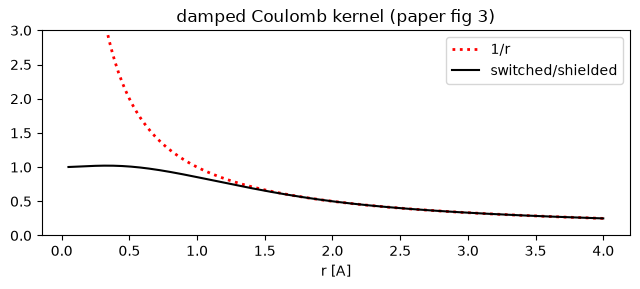
\(E_{\rm ele} = k_e/2\; q_i q_j \big[(1{-}s(r))/\sqrt{r^2+1} + s(r)/r\big]\) with the smoothstep \(s\) switching at \(r_{\rm cut}/2\): shielded at short range to avoid the singularity, exact Coulomb beyond. With a long-range cutoff the expression is force-shifted to vanish smoothly.
Eele_tf = sess.run(Eele_op)
Eele_x = x.electrostatic_energy_per_atom(D_x, Qa_x, ei[1], ei[0])
print("electrostatic energy per atom [eV]:", Eele_x.detach().numpy().round(5))
print("max |Eele diff| =", np.abs(Eele_x.detach().numpy() - Eele_tf).max())

rr = torch.linspace(0.05, SR_CUT, 300)
sw = x._switch(rr)
chi = (1 - sw) / torch.sqrt(rr**2 + 1) + sw / rr
fig, ax = plt.subplots(figsize=(6.5, 3))
ax.plot(rr, (1 / rr).numpy(), "r:", lw=2, label="1/r")
ax.plot(rr, chi.numpy(), "k-", label="switched/shielded")
ax.set_ylim(0, 3); ax.set_xlabel("r [A]"); ax.legend()
ax.set_title("damped Coulomb kernel (paper fig 3)"); plt.tight_layout(); plt.show()
electrostatic energy per atom [eV]: [-4.85618  0.24051  0.07047 -1.32503  0.15197 -0.17815  0.1629   0.6113 ]
max |Eele diff| = 5.828670879282072e-15
Block 6: Grimme D3(BJ) dispersion#
xnn.dnn.models.d3 is an independently written implementation of the
D3(BJ) dispersion (coordination numbers, Gaussian-weighted C6 interpolation
from the reference tables, BJ damping) that reproduces the TF grimme_d3
module exactly; the tables ship with xnn. \(s_6, s_8, a_1, a_2\)
are learnable through a softplus, initialized to the HF values.
Edisp_tf = sess.run(Edisp_op)
Edisp_x = x.dispersion_energy_per_atom(torch.tensor(Z_np), D_x, ei[1], ei[0])
print("dispersion energy per atom [eV]:", Edisp_x.detach().numpy().round(6))
print("max |Edisp diff| =", np.abs(Edisp_x.detach().numpy() - Edisp_tf).max())
print("s6, s8, a1, a2 =", [round(float(v), 4) for v in (x.s6, x.s8, x.a1, x.a2)])
dispersion energy per atom [eV]: [-0.122002 -0.102835 -0.094091 -0.200128 -0.12701  -0.071694 -0.096155
 -0.109732]
max |Edisp diff| = 8.326672684688674e-17
s6, s8, a1, a2 = [1.0, 0.9171, 0.3385, 2.883]
Capstone: transplant a whole PhysNet and compare E, F, q, p#
The end-to-end check through ForceStressOutput (same autograd-forces path as
every xnn model): same weights → same function.
from xnn.common.data import AtomicGraph

E_tf, F_tf = sess.run([E_op, F_op])
graph = AtomicGraph(pos=pos.clone(), atomic_numbers=torch.tensor(Z_np),
                    edge_index=ei, cell_shifts=torch.zeros(len(idx_i), 3, dtype=torch.long),
                    batch=torch.zeros(N, dtype=torch.long), n_atoms=torch.tensor([N]),
                    cell=None, pbc=None)
graph.total_charge = torch.tensor([Q_TOT])
out = ForceStressOutput(x)(graph)
print(f"E  original = {float(E_tf):.12f}   xnn = {float(out['energy']):.12f}")
print(f"|dE| = {abs(float(out['energy']) - float(E_tf)):.2e}   "
      f"max|dF| = {np.abs(out['forces'].detach().numpy() - F_tf).max():.2e}   "
      f"max|dq| = {np.abs(out['charges'].detach().numpy() - Qa_tf).max():.2e}")
print("dipole [eA] =", out["dipole"].detach().numpy().round(5))
sess.close()
E  original = -0.562483036399   xnn = -0.562483036399
|dE| = 4.00e-15   max|dF| = 7.17e-15   max|dq| = 8.60e-16
dipole [eA] = [[ 0.92905 -0.18352 -0.29534]]
Summary#
block |
original TF PhysNet |
|
max diff (float64) |
|---|---|---|---|
element embedding (eq 3) |
|
|
0 |
radial basis (eqs 7–8) |
|
|
~1e-15 |
interaction + residual blocks (eqs 4–6) |
|
|
~1e-14 |
output blocks + scale/shift (eqs 9–10) |
|
|
~1e-14 |
charge correction (eq 14) |
|
|
~1e-15 |
electrostatics (eqs 12–13) |
|
same math, independent code |
~1e-15 |
D3(BJ) dispersion |
|
|
~1e-15 |
whole model |
E, F, q to float64 round-off |
The xnn PhysNet is an independent pure-PyTorch implementation of the
original TensorFlow 1.x PhysNet, verified against it block by block: one model class on the shared xnn abstractions
(InteratomicPotential, scatter_sum, ForceStressOutput autograd
forces/stress), with charges and dipoles as extra outputs. Next:
physnet_argon_train_test.ipynb trains both implementations on Argon MD
data.